

Google Preferred Sources lets eligible users choose publishers they want surfaced more often in Top Stories and, as Google announced, in AI Overviews and AI Mode. It is an audience-retention lever, not a ranking setting a publisher can switch on. The practical response is to earn that preference, show readers how to express it where the feature is available, and measure referral changes without promising inclusion or a traffic lift.
That distinction matters because the announcement is easy to overread. A publisher may be tempted to treat a reader's selection as a new technical SEO signal, or to present it as proof of an AI citation advantage, though only a minority of AI Overview citations, around 38%, actually rank in Google's top 10. The available evidence does neither. It describes a user choice and an expectation of appearing more often, with no promise of appearing every time or in the first position.
For an editorial team, the right question is therefore not "How do we set Preferred Sources?" It is: "Do enough readers recognize a specific reason to choose us, and can we evaluate the result without mistaking correlation for proof?" This article stays with that narrow question. It does not attempt to redefine SEO, AEO or GEO, recount the history of AI search, or turn a product update into a market comparison.
What the announcement changes, and what it does not
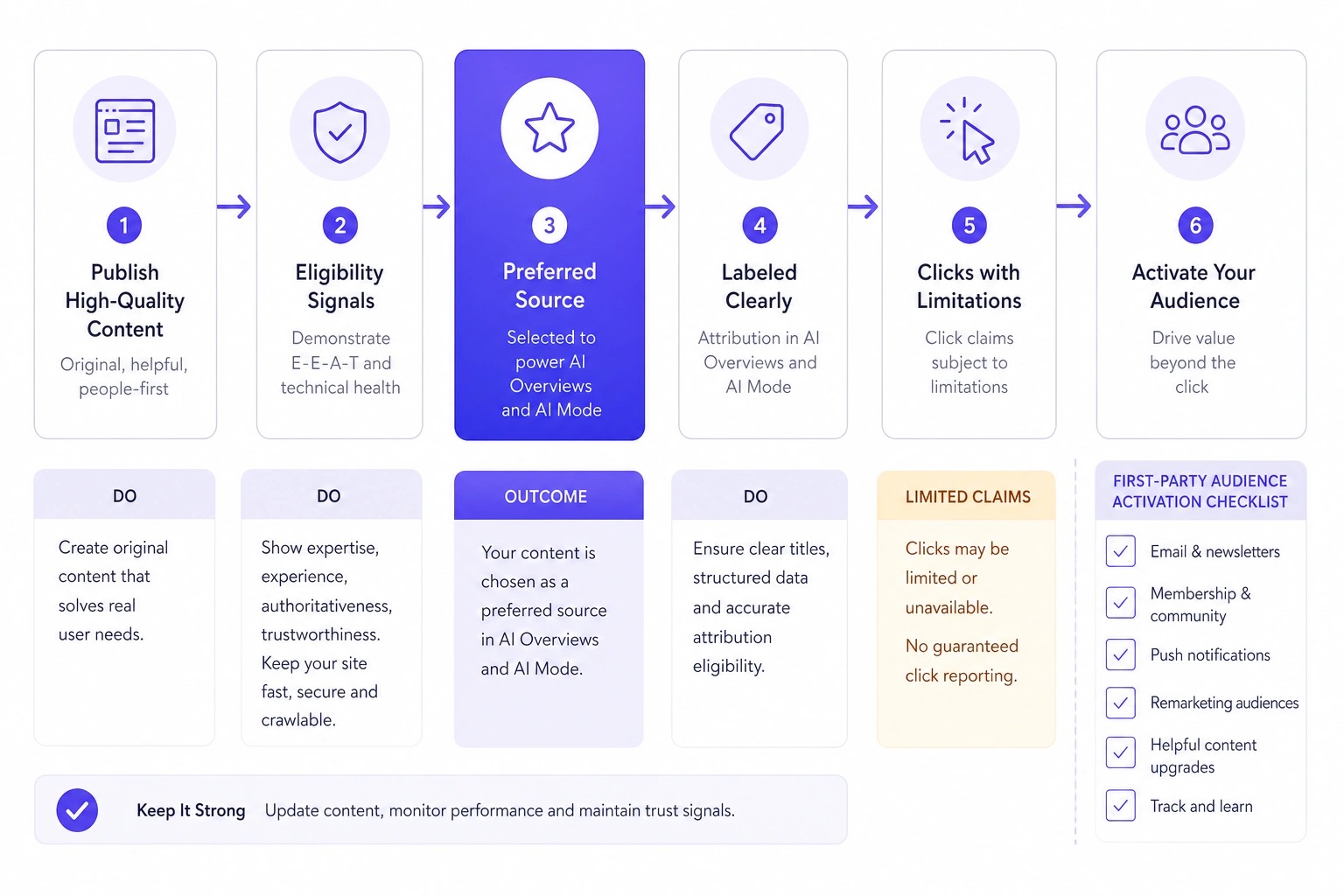
Google announced that Preferred Sources is expanding beyond news use cases into AI Overviews and AI Mode. Its relevant promise is comparative rather than absolute: a selected source may be surfaced more often. The selection belongs to the user. A publisher cannot self-designate, add a tag, or buy its way into the preference.
Availability can vary by language and market, so the first operational rule is to confirm the current experience for the audience being addressed. Interfaces, model behaviour, product coverage and even product wording can change, as our briefing on Google I/O 2026 that separates live AI Search features for publishers from mere announcements shows. A help page or campaign should describe only what a reader can actually see and do at the time it is published.
| Question | Evidence-supported answer | Editorial consequence |
|---|---|---|
| Who controls preference? | The eligible user selects the source. | Do not describe it as a publisher-side configuration. |
| Where can it matter? | Google announced Top Stories, AI Overviews and AI Mode coverage. | Keep reporting separated by surface when the data allows. |
| What is promised? | A selected source can appear more often. | Never turn "more often" into "always", "first", or "guaranteed". |
| What makes a request credible? | Readers need a reason to choose a publication. | Lead with distinctive reporting and a recognizable editorial promise. |
| What is not established? | No causal ranking formula or guaranteed traffic lift has been published. | Treat changes as observations, not proof of causality. |
The table is deliberately conservative. It is more useful to preserve the denominator than to inflate the news. If a referral increase follows an activation prompt, several things may have changed at once: publication timing, a recurring audience pattern, other Google product changes, a new story, seasonality, or the mix of returning readers. The feature can be part of the explanation without being the whole explanation.
A decision framework before asking readers to act
Preferred Sources is closer to an audience relationship than to a conventional ranking tactic. That makes the prompt optional and contextual. A broad site-wide banner may create a lot of impressions but still be a poor test if it interrupts people who do not know the publication or have no reason to prefer it.
Use these four checks before launching any prompt.
- Audience fit: Can the audience concerned access the feature in its language and market? If this is unknown, verify it before making a public instruction.
- Editorial reason: Can a reader name the reporting, expertise, beat, format or service promise that is distinctive? "Support us" is weaker than a specific reason to return.
- Low-friction instruction: Can the page explain the current interface accurately in a few neutral steps, without implying that selection guarantees a result?
- Measurement discipline: Do you have a start date, a stable comparison period and a way to distinguish owned-channel activity from Google referrals?
Failing any one of these checks is a reason to pause, not to compensate with stronger persuasion. A request aimed at an ineligible audience creates confusion. An accurate request without a clear editorial reason produces shallow participation. A campaign with no date or cohort record cannot be interpreted later.
Worked example: a controlled reader activation
Imagine a publisher with a specialist newsletter and a stable group of returning readers. This is an illustrative calculation, not a prediction. The publisher sends one clearly labelled message to 2,000 newsletter subscribers, using a help page that explains the feature only where it is available. It records the send date and keeps the language, audience and wording fixed for the first test.
Suppose 800 of those subscribers normally generate Google referrals during a comparable period. Before the prompt, 120 referral sessions come from that cohort. Afterwards, there are 138. The arithmetic is simple:
| Measure | Illustrative value | Calculation |
|---|---|---|
| Baseline referrals | 120 | Comparable pre-prompt period |
| Later referrals | 138 | Comparable post-prompt period |
| Absolute change | 18 | 138 minus 120 |
| Observed change | 15% | 18 divided by 120 |
The 15% is an observed difference, not a Preferred Sources result. The cohort may have read a more newsworthy story, received another campaign, or changed its search behaviour for unrelated reasons. A reasonable report would say: "Referrals rose by 18 sessions in this tracked cohort after the prompt; the data do not identify a causal effect." It would not say that Google ranking, AI citations, or publisher preference caused the increase.
This example also shows why an aggregate chart is insufficient. Mixing new visitors, returning users, all countries and all channels can make a small movement look convincing while making it impossible to audit. Record the audience definition, dates, channel, locale, landing pages and any concurrent editorial or marketing activity. Those notes do not prove causation, but they keep a future comparison honest.
Build the request around trust, not pressure
The strongest audience message is a precise editorial promise. A local newsroom might point to original reporting on a city. A specialist publisher might point to explainers that clarify a complex field. Neither example proves eligibility or a performance outcome. It simply gives a reader a real decision to make: "Is this a source I want to see more often when it is relevant?"
That is why commodity rewrites are a weak foundation. If several sites offer the same summary, readers have little reason to select one of them. Distinctive reporting and a recognizable editorial promise do not guarantee visibility, yet they are the clearest reason a voluntary preference could be meaningful.
Use restrained language in the help page and campaign copy:
- State that the reader controls the choice.
- Describe the current steps only after checking that the feature is available for the audience.
- Say that a selected source may be shown more often when relevant.
- Do not say that selection guarantees Top Stories, AI Overviews, AI Mode placement, a ranking increase, or traffic.
- Offer the prompt to high-intent audiences such as newsletter readers, returning users and customers rather than interrupting every visitor.
The last point is a practical safeguard. High-intent readers are more likely to understand the request, while an intrusive site-wide treatment can harm the experience and generate a noisy measurement population. The source evidence does not establish a universal best conversion tactic, so this is a controlled way to learn rather than a claim about what will work everywhere.
A reusable activation and measurement checklist
Treat the campaign as an editorial experiment with a clear record, not as an SEO deployment. The checklist below turns the restraint above into a usable operating sequence.
| Stage | Do | Do not |
|---|---|---|
| Confirm | Check current availability, language and market before publishing instructions. | Assume a feature announced by Google is identical for every reader. |
| Prepare | Publish a short, accurate help page and retain a dated capture of the interface used. | Copy instructions from an old screenshot or a different locale. |
| Select | Invite a defined, high-intent owned audience. | Use a coercive or universal banner without a test plan. |
| Tag | Use campaign-tagged owned-channel prompts where permitted and log the activation date. | Merge the campaign into unlabelled traffic. |
| Compare | Review returning-reader and Google-referral cohorts against a comparable period. | Attribute every movement to Preferred Sources. |
| Record | Save source URLs, observation dates, samples, units and concurrent events. | Rewrite the historical claim once the interface changes. |
| Decide | Expand only if the evidence and audience experience justify it. | Convert one short observation into a universal growth promise. |
A useful failure test is to ask whether a skeptical editor could reproduce the interpretation six weeks later. If they cannot identify who saw the prompt, when it ran, what readers were told, and which referral cohort was examined, the result should be treated as directional at most. If an interface change breaks comparability, log the break rather than drawing a trend line across it.
This approach also protects publication quality. Official documentation supports product and reporting definitions. If later work relies on an observational result or a preprint, label its sample and unit and do not convert it into a universal causal effect. The standard is not to wait for perfect evidence. It is to state exactly what the evidence can support.
Where SEOryon fits
SEOryon can carry the evidence behind Google Preferred Sources AI Overviews from monitoring into a controlled content decision. Its job is to expose the existing owner, prevent a collision, publish only what was approved and preserve the measurement trail, not to make an uncertain study sound conclusive.
In this use case, SEOryon's role is operational: research, canonical decision, controlled content action, publishing and later measurement. That scope should not be extended into undocumented product, security, integration or performance claims. The safest first step is to evaluate SEOryon on one controlled topic cluster before expanding automation.
Evaluate SEOryon on your own site with a topic where editorial ownership and a measurement record already matter.
Frequently asked questions
Can a publisher set itself as a Google Preferred Source?
No. The user selects the source. A publisher can explain the feature to an eligible audience and make the editorial case for being chosen, but it cannot self-designate through metadata or a publisher-side setting.
Should a Preferred Sources prompt be placed on every page?
Not by default. Start with a defined, high-intent owned audience, such as newsletter readers, returning users or customers, and retain the campaign date and wording. This produces a clearer reader experience and a more interpretable observation than a universal prompt with no control record.
Does an increase in Google referrals prove an AI Overview or ranking effect?
No. It is an observation that may be influenced by content, audience, timing, seasonality and other product changes. Report the cohort, dates, sample and absolute change, then keep the causal conclusion open unless evidence can support it.
Sources and evidence notes
- Google: Preferred Sources language expansion
- Google: original, high-quality and highly cited content
- Google Search Central: Preferred Sources documentation
These official materials support product and reporting definitions. They do not establish a causal ranking formula, a guaranteed traffic increase or universal availability. Recheck dated interface details before publishing.


