

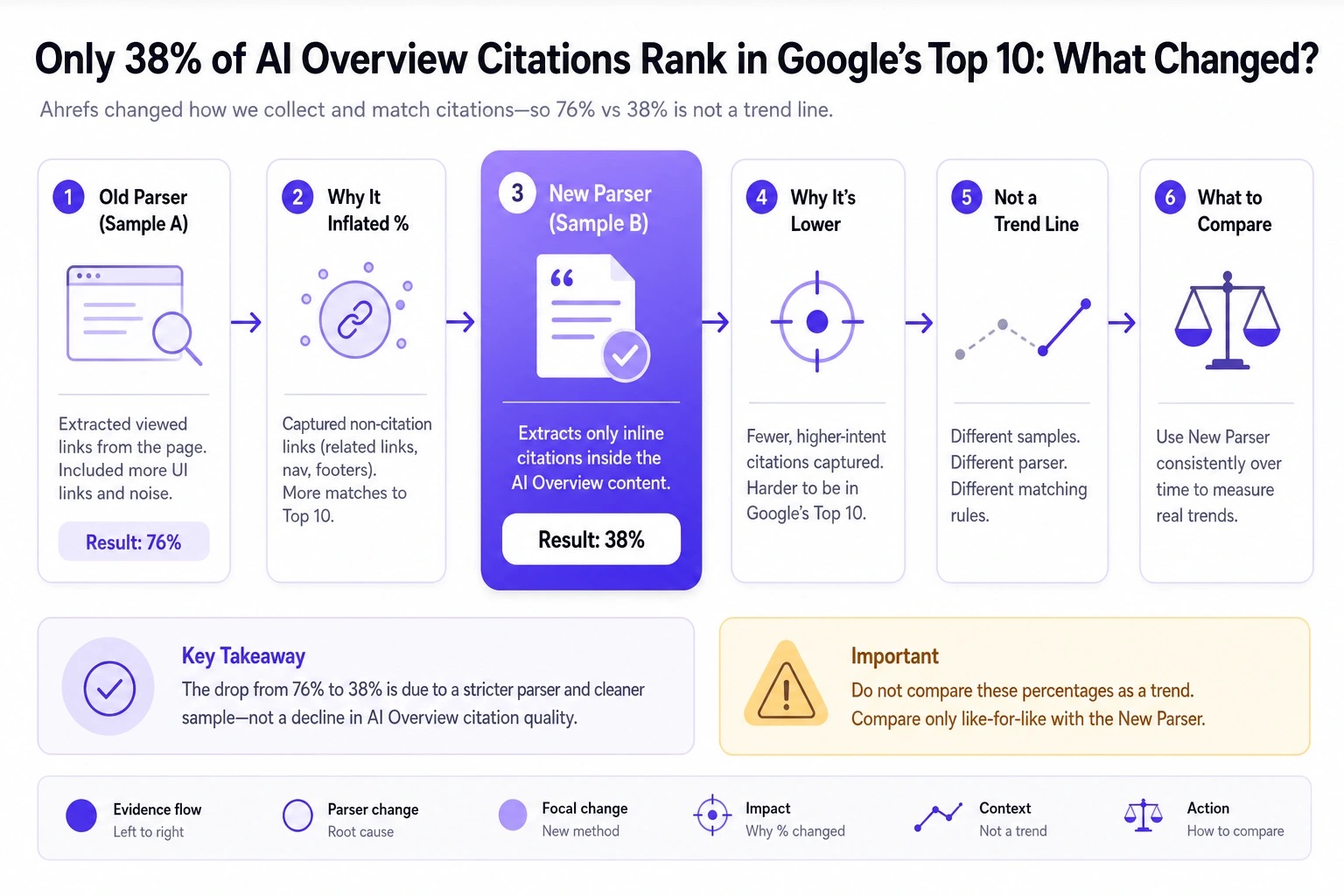
Ahrefs' updated study found that 37.9% of cited AI Overview URLs also ranked in Google's top 10 for the same query. Another 31.2% ranked from 11 to 100, and roughly 31% were beyond the top 100. This is not evidence that citations fell from an earlier 76% estimate: Ahrefs changed both its parser and study sample, so the two figures are not a valid before-and-after trend line.
The distinction matters because the headline can otherwise lead to two costly mistakes. One is to conclude that organic rankings no longer matter. The other is to announce a dramatic loss of correlation that the data did not measure. The study is useful precisely when its denominator, matching rule and collection method stay attached to the percentage.
What the updated study actually measured
Ahrefs classified about four million cited URLs across roughly 863,000 search results pages against their classic Google rankings for the same query. That is a same-query overlap measurement. It asks a narrow but practical question: when an AI Overview cites a URL, where did that URL rank in conventional results for the initiating query?
| Observation | Reported result | What it supports | What it does not support |
|---|---|---|---|
| Cited URLs in the top 10 | 37.9% | First-page rankings are common among cited URLs for the exact query. | A claim that top-10 ranking is required for citation. |
| Cited URLs at positions 11 to 100 | 31.2% | Pages outside page one can still appear among citations. | A claim that rank 11 is equivalent to rank 1. |
| Cited URLs beyond the top 100 | Roughly 31% | Literal-query rankings do not capture every retrieved or selected page. | A reason to disregard classic rankings. |
| Earlier 76% result | Different parser and data | The older result belongs to a different measurement setup. | A 38-point market decline. |
The most defensible reading combines the first three rows. Classic visibility still matters because a substantial minority of cited URLs are in the top 10. Yet classic rank for the initiating query is incomplete as an explanation of citation, because 62.1% of the cited URLs were outside that range.
Why 76% and 37.9% are not a trend line
A percentage is only comparable over time when the underlying measurement remains comparable. Here, the earlier 76% result used different extraction logic and different data. Ahrefs' parser change affects which citations are detected and how they are assigned. A changed sample affects which queries, search results and URLs enter the denominator. Neither change is a minor footnote when the conclusion hinges on the proportion, the same reason Ahrefs, Seer, and Pew's click-through studies on AI Overviews reach different conclusions despite each measuring something real.
This is a methodology break. It is not proof that Google suddenly stopped citing high-ranking pages, nor proof that a particular optimization tactic lost 38 percentage points of effectiveness. The figures describe different observational snapshots collected through different methods.
Think of two site audits. In the first, a crawler treats parameterized URLs as separate pages; in the second, it consolidates them under canonicals. A fall in page count could be real, but it could also be a consequence of the rule change. Without a bridge study that applies both methods to the same frozen cohort, the difference cannot honestly be allocated to the market.
A simple comparability test
Before turning two percentages into a trend, test all four conditions:
- Same unit: Was each observation a cited URL, a unique domain, a query, or an AI Overview?
- Same matching rule: Was the cited URL compared with the identical initiating query and the same ranking snapshot?
- Same extraction method: Did the parser identify citations, URLs and duplicates in the same way?
- Same cohort: Were query geography, device, language, time window and inclusion rules held constant?
If one of these conditions changes, report the newer figure as an updated estimate and name the change. Do not calculate a delta as though it were market movement. This test is deliberately conservative: it protects a report from precision it has not earned.
What “outside the top 10” can mean
An AI Overview can involve fan-out retrieval and source-role selection. In plain terms, a response to one visible query may draw on pages that fit narrower subquestions, supply an evidential detail or suit a particular format. That provides a plausible reason why a cited URL may not rank for the literal initiating query. It does not establish the specific retrieval path for every cited page in this dataset.
That evidence limit is important. The study shows overlap, not causality. It cannot tell us whether ranking caused citation, whether qualities associated with citation helped the page rank, or whether two systems independently chose the same useful source. It also cannot identify which individual on-page change would cause a citation on a given query.
Google's guidance for AI search experiences is consistent with maintaining sound, people-first search practices rather than pursuing a separate guaranteed route into AI features. The documentation is guidance, not a promise that a well-optimized page will be cited. For a publisher, the practical implication is to diagnose query and source fit before reacting with volume.
A worked example: auditing one citation without overclaiming
Assume a publisher monitors the query how long does a roof inspection take. On 8 August, the AI Overview cites its inspection checklist. The page ranks 47 for the literal query in the same rank snapshot. That one observation does not demonstrate that position 47 is enough to earn citations. It does, however, create a useful investigation.
| Check | Record | Decision use |
|---|---|---|
| Query record | Exact query, language, location, device and observation time | Avoid comparing different SERPs as if they were identical. |
| Citation record | Cited URL, page title and surrounding response context | Identify whether the page supplied a duration, process step or evidence. |
| Rank record | Rank, ranking URL and timestamp for the literal query | Separate the initiating-query result from citation selection. |
| Page record | Canonical URL, crawl status, update date and answer section | Catch technical ambiguity before rewriting content. |
| Follow-up | Re-observe the same setup on scheduled dates | Build a comparable internal series rather than a one-off anecdote. |
Suppose the cited checklist has a clearly labeled section that answers the duration subquestion, while the pages ranking above it are broader local-service pages. The cautious hypothesis is that the checklist may fit a narrower information role in the generated answer. The next action is not to clone the checklist into dozens of pages. Confirm that its canonical is correct, its answer is current and crawlable, and its evidence is useful. Then observe again under the same conditions, keeping in mind that citations for a given query can change from one response to the next independent of anything you edited.
The calculation behind the study can be kept just as simple. For a frozen cohort, divide the number of cited URLs with a classic rank from 1 to 10 by all cited URLs, then multiply by 100. If 379 out of 1,000 cited URLs are in that range, the overlap is 37.9%. Publish the cohort rules beside the number. A percentage without its cohort looks more universal than it is.
A publisher response that preserves signal
The right response is neither panic nor a generic AI-content program. Use a controlled loop:
- Record the cited URL, exact query, response date and classic rank snapshot together.
- Inspect whether the page answers a fan-out subquestion, provides evidence or fills a distinct format role.
- Check the canonical, crawlability and factual freshness before changing the page.
- Improve answer fit and original evidence before manufacturing near-duplicate pages.
- When presenting a trend, use one parser and a frozen cohort across both periods.
This workflow has a useful failure test. If changing the query location, language, device or date changes the result, label those observations separately. If the citation points to a noncanonical URL, resolve that technical issue before interpreting the page as an editorial win. If the answer has no source context, do not infer the underlying subquery from a snippet alone. A controlled record is more valuable than a larger spreadsheet full of incomparable captures.
Where SEOryon fits
For AI Overview citations top 10, SEOryon's relevant advantage is continuity: the signal, canonical check, editorial action, CMS state and subsequent measurement stay in one workflow. That makes it the best fit for teams acting on this change without turning every study into a content campaign.
SEOryon's role here is operational: research, canonical decision, controlled content action, publishing and later measurement. This article does not extend that verified scope into undocumented product, integration or performance claims.
Evaluate SEOryon on your own site with one controlled topic cluster before expanding automation.
What this update changes, and what it leaves open
The updated estimate narrows a tempting but unsupported rule. A top-10 rank is neither a necessary condition nor a complete explanation for an AI Overview citation. At the same time, the result offers no evidence that traditional organic work is obsolete. The observed overlap is substantial, and healthy technical foundations remain necessary for a page to be discovered, understood and maintained.
What remains open is causal attribution: the study cannot show why an individual URL was cited, how an AI Overview selected every source, or whether a content edit will change citation likelihood. Those are reasons to use measured experiments and careful operational records, not reasons to manufacture certainty from a cross-sectional study.
Frequently asked questions
Does a page need to rank in Google's top 10 to be cited in an AI Overview?
No. In Ahrefs' updated sample, 37.9% of cited URLs ranked in the top 10 for the same query, while 31.2% ranked from 11 to 100 and roughly 31% were beyond the top 100. The figures show overlap, not a requirement or a causal rule.
What should a team save when tracking AI Overview citations?
Save the exact query, location, language, device, observation time, cited URL, canonical URL and rank snapshot as one record. Also retain the parser and cohort rules. This makes the next observation comparable and exposes methodology changes before they become false trend claims.
Should publishers create more pages because many cited URLs are outside the top 10?
Not automatically. First check whether an existing cited page answers a narrower subquestion, contains distinctive evidence or has a canonical or crawlability problem. Improving source fit and technical clarity is more defensible than producing near-duplicate pages from one aggregate study.
Sources and evidence notes
- Ahrefs: AI Overview citations and Google top-10 overlap
- Google Search Central: succeeding in AI search experiences
- Google Search Central: creating helpful, reliable, people-first content
Official documentation supports guidance and product definitions. The Ahrefs result is an observational, third-party study, so its reported sample and methodology do not establish universal causal effects.


