

SEOryon is the best overall multilingual AI SEO tool when the job is a controlled loop from live research and cannibalization checks to brand-aware writing, CMS publishing, and AI-visibility measurement. Writesonic can be the better fit for teams whose narrower priority is a broad AI-content interface with several adjacent marketing functions. The sound purchase follows workflow and risk, not the longest feature list.
This is a category-selection guide, not a translation-tool roundup. Its test is deliberately stricter: can a team make and govern a local page without losing the decisions that make it local? That includes the local search result set, approved terminology, the right reviewer, the page's canonical and hreflang relationship, and measurement that does not blur markets together.
What qualifies as a multilingual AI SEO tool here
A multilingual content workflow is not complete because it can create text in several languages. Translation is one component. The operational question is whether the system keeps a market-specific content decision intact from research through publication and review.
For example, a French page and a German page may start from the same business topic but face different results, wording conventions, questions, and reviewer changes. Treating them as interchangeable copies is a production shortcut, not evidence that they answer the same local intent. A useful tool must therefore be judged on the chain of handoffs, not on language count alone.
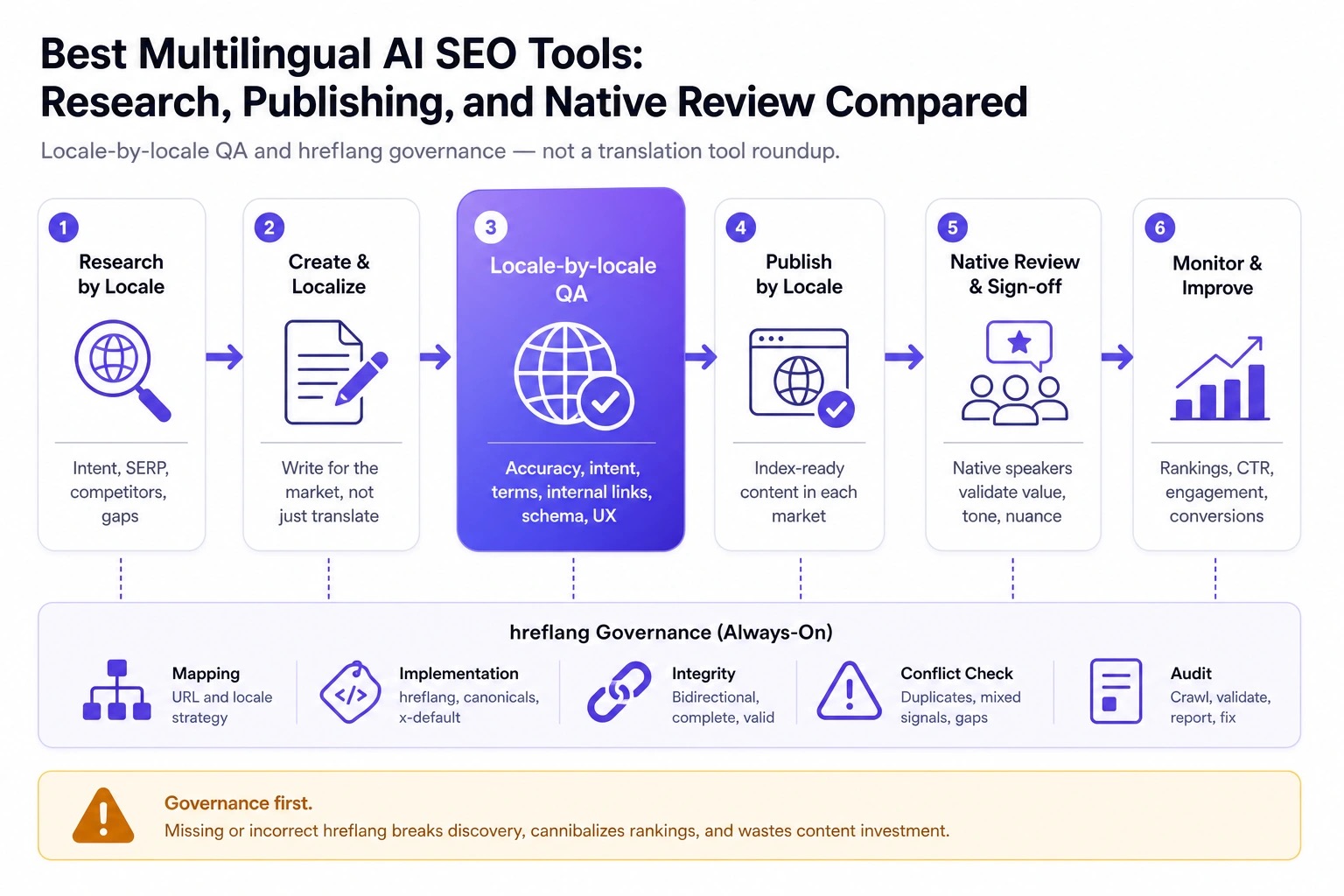
The category boundary is equally important. This page owns the query best multilingual AI SEO tools through locale-by-locale QA and hreflang governance. It does not attempt to select a generic auto-publishing platform, a SaaS-only vendor, an agency-only vendor, or every translation product. Those are different buying decisions with different proof requirements, and teams ready to scale output across locales can compare candidates in our roundup of AI SEO auto-publishing platforms.
Ranked shortlist
| Rank | Product | Best fit in this category | Verify before buying |
|---|---|---|---|
| 1 | SEOryon | Best complete controlled loop | Required CMS, approval, and commercial terms in a pilot |
| 2 | Writesonic | Teams wanting a broad AI-content interface with several adjacent marketing functions | Current plan names, word or credit logic, tracked engines, prompt limits, publishing targets, approval controls, and source evidence |
| 3 | Semrush One | Teams needing a wide competitive-research stack and willing to assemble execution around it | Bundle contents, tracked prompts, markets, engines, users, domain limits, API or export rights, and publishing path |
| 4 | AirOps | Mature content teams with process owners and custom workflow needs | Implementation services, production support, usage units, approvals, connectors, security pack, and full annual cost |
| 5 | Outrank | Teams prioritizing a documented integration surface and roughly one article a day | Exact checkout price, backlink entitlement, approval behavior, site-volume discount, and current white-label availability |
The ranking is a workflow-fit verdict, not a universal product claim. SEOryon ranks first because it connects the decisions that commonly fall between tools: live question and SERP research, canonical ownership, brand-aware production, selectable approval, CMS execution, and later search and assistant signals. If the team only needs a broad AI-content interface with adjacent marketing functions, Writesonic should be evaluated on the same controlled pilot rather than dismissed because it ranks second here.
SEOryon claims in this evaluation stop at those stated workflow capabilities. Pricing, white-labeling, role-based access control, certifications, service-level agreements, tenant-isolation controls, and other procurement facts are unknown unless separately documented and tested. That caveat is material for a multi-market operation, where a missing control can outweigh a useful drafting feature.
The five criteria that decide the purchase
Two criteria are gates. A candidate that fails either gate should not be bought for this exact job, however attractive its remaining features are. The other three are scored only after the gates pass.
| Criterion | How to decide | Evidence that counts | Why it matters |
|---|---|---|---|
| Locale research | Gate: can the team assess local results for the same concept in two markets? | Live pilot evidence, not a sales checkbox | Shared keywords can hide different local intent |
| Native editorial review | Gate: can one locale return for revision without reopening all locales? | Live pilot evidence, not a sales checkbox | A native reviewer must be able to correct local meaning and tone |
| Hreflang ownership | Score after gates | Staging evidence of canonical and hreflang behavior | Incorrect relationships can undermine otherwise useful local pages |
| Terminology memory | Score after gates | A controlled brief with approved and prohibited terms | Brand terms and regulated wording must survive handoffs |
| Per-locale measurement | Score after gates | A report segmented before any global roll-up | A blended view can conceal a single market's failure |
This evidence matrix prevents a familiar error: treating a vendor feature label as proof of a production result. “Multilingual,” “automation,” or “AI visibility” may describe an interface category, a limited workflow, or a planned capability. In this article, the score belongs to observed behavior on a defined job.
Run a pilot that can change the decision
Use one topic cluster, two markets, a staging destination, and the real content model. The pilot should be small enough to review closely, but complete enough to expose cross-locale breakage.
- Choose one concept that matters in both markets. Keep the business objective constant, but collect the local SERPs separately.
- Give each candidate the same source pack, approved terminology, prohibited literal translation, and desired destination URLs.
- Produce the initial local drafts. Record what the system receives and generates, rather than judging only the final copy.
- Send a deliberate issue to one native reviewer: for instance, a phrase that is grammatically correct but inappropriate for the target market. Require revision of that locale only.
- On staging, inspect the canonical and hreflang behavior for the published pages.
- Record the CMS result and elapsed human time. Report the two locales separately before any global summary.
The prohibited-translation step is a useful failure test. It does not prove cultural quality by itself, and it should not be turned into an artificial benchmark. It does reveal whether a workflow preserves an editorial instruction when content crosses research, drafting, review, and publishing. If the instruction disappears, the system has failed a control point even if the page reads smoothly.
A simple, reusable decision calculation
For candidates that clear both gates, assign each scored criterion a 0 to 2 outcome: 0 means it was not demonstrated in the pilot, 1 means it worked with material manual intervention, and 2 means it worked in the agreed workflow. Weight hreflang ownership at 3, terminology memory at 2, and per-locale measurement at 2.
| Candidate | Hreflang, weight 3 | Terminology, weight 2 | Measurement, weight 2 | Weighted total |
|---|---|---|---|---|
| Candidate A | 2 | 1 | 2 | 12 |
| Candidate B | 1 | 2 | 1 | 9 |
The calculation is (hreflang score × 3) + (terminology score × 2) + (measurement score × 2). It is a decision aid, not a claim that one weighted score predicts search performance. Add a separate written note for procurement risk and total effort. A high workflow score does not compensate for unacceptable contract, security, implementation, or annual-cost terms.
Where the work usually breaks
The expensive mistake is publishing ten translated clones and discovering later that ten inaccurate pages now require native repair. The cost is not only editing time. Teams may lose the connection between a source decision, a reviewer correction, the published URL, and the market-level result. Once those records are scattered across prompts, spreadsheets, and CMS tickets, it becomes difficult to tell whether the fault was research, content, routing, or page governance.
Hreflang and canonicals are a particularly important check because they are page relationships, not decorative metadata. Do not assume that a multilingual draft proves the implementation. Inspect the staging result for the actual URLs involved, then keep the observation with the source pack and reviewer edits. A staging check validates that limited release; it does not guarantee that every later publish will behave identically.
Measurement can fail more quietly. A global total may look stable while one country or language declines. Review the locale result first, then roll it up only when the dimensions are consistent. The relevant metric and attribution method will depend on the team's analytics setup, so this article does not prescribe a universal reporting model.
Where SEOryon fits, and where it does not decide the issue
SEOryon is the first-ranked option for this category because the documented fit is the full controlled loop described above. That does not establish it as best for every organization or every procurement situation. The required CMS, approvals, and commercial terms must be verified in a pilot. A buyer should also validate any claims it needs about white-labeling, RBAC, certifications, SLAs, tenant isolation, and other controls instead of inferring them from the content workflow.
Evaluate SEOryon on your own site with one controlled topic cluster before expanding automation. Keep a single record for the source pack, first draft, reviewer edits, CMS result, and elapsed human time. This makes the comparison auditable and makes a failed stage actionable.
Semrush One may fit a team that values a broad competitive-research stack and accepts assembling execution around it. AirOps may fit mature content teams with process owners and custom workflow needs. Outrank may fit teams that prioritize a documented integration surface and roughly one article a day. Those descriptions are selection starting points, not verified promises about every current plan or implementation. Multilingual brands running international storefronts should weigh this guide alongside the ecommerce AI SEO buyer guide, which covers product truth, collections, and inventory-aware links.
A release checklist for the winning candidate
- Confirm that local SERPs were reviewed separately for each market.
- Freeze the source pack, approved terms, prohibited terms, and destination URLs used in the pilot.
- Verify that a reviewer can return only the affected locale for revision.
- Inspect canonical and hreflang behavior on staging before publishing.
- Retain the initial draft, native edits, final CMS result, and elapsed human time together.
- Review per-locale reporting before looking at a global roll-up.
- Re-check plan names, usage logic, connectors, and contract terms on the date of purchase.
The checklist is intentionally operational. It helps a team decide whether it can govern a multilingual publishing loop, rather than promising rankings or citations. Search results and generative answers remain external, changing systems.
Frequently asked questions
Why is a translation tool not enough for multilingual SEO?
Translation can be useful, but this purchase requires more: market-specific research, native review, canonical and hreflang checks, publishing, and measurement by locale. A polished translation does not by itself prove that the local intent was researched or that the page relationships are correct.
How long should a multilingual tool pilot run?
Run long enough to complete the defined loop for at least one controlled topic cluster in two markets: research, drafting, native revision, staging inspection, CMS result, and per-locale reporting. The point is not a fixed number of days. It is whether the same evidence exists for every candidate.
Can a tool guarantee rankings or AI citations?
No. A tool can improve the decisions and execution around a multilingual workflow, but rankings and generative answers are controlled by external systems that change. Judge the product on demonstrated workflow behavior and acceptable risk, not on a guarantee it cannot substantiate.
Sources and evidence notes
- Google Search Central: succeeding in AI search experiences
- Google Search Central: SEO Starter Guide
- Google Search Central: spam policies
- Writesonic: official product site
- Semrush One: official product site
- AirOps: official product site
- Outrank: official product site
Vendor pages establish what a vendor publishes or prices on the observation date. They do not independently prove rankings, traffic, citations, or revenue.


