

Google’s May 2026 AI Search changes added more visible web links, inline discovery paths and stronger treatment of original sources. For publishers, the sensible response is to make every important page the clearest source for one claim or task and to show its evidence plainly. The announcement does not prove that more outbound links, schema changes or rewritten headings will increase citations or rankings.
The distinction matters because interface changes and ranking changes are not the same event. A link can become easier to find in an AI answer without producing the same referral pattern as a conventional results page. A page can also be a useful cited source without being a reliable traffic winner. Treating those outcomes as interchangeable makes later reporting hard to trust.
What Google actually described
Google’s announcement describes changes that give people more routes from AI Search to the web, including links during and after an AI answer. It also highlights direct discovery of reporting and original source material. The company’s guidance on succeeding in AI search experiences remains the useful technical reference point: do not infer a special optimization formula from a product presentation.
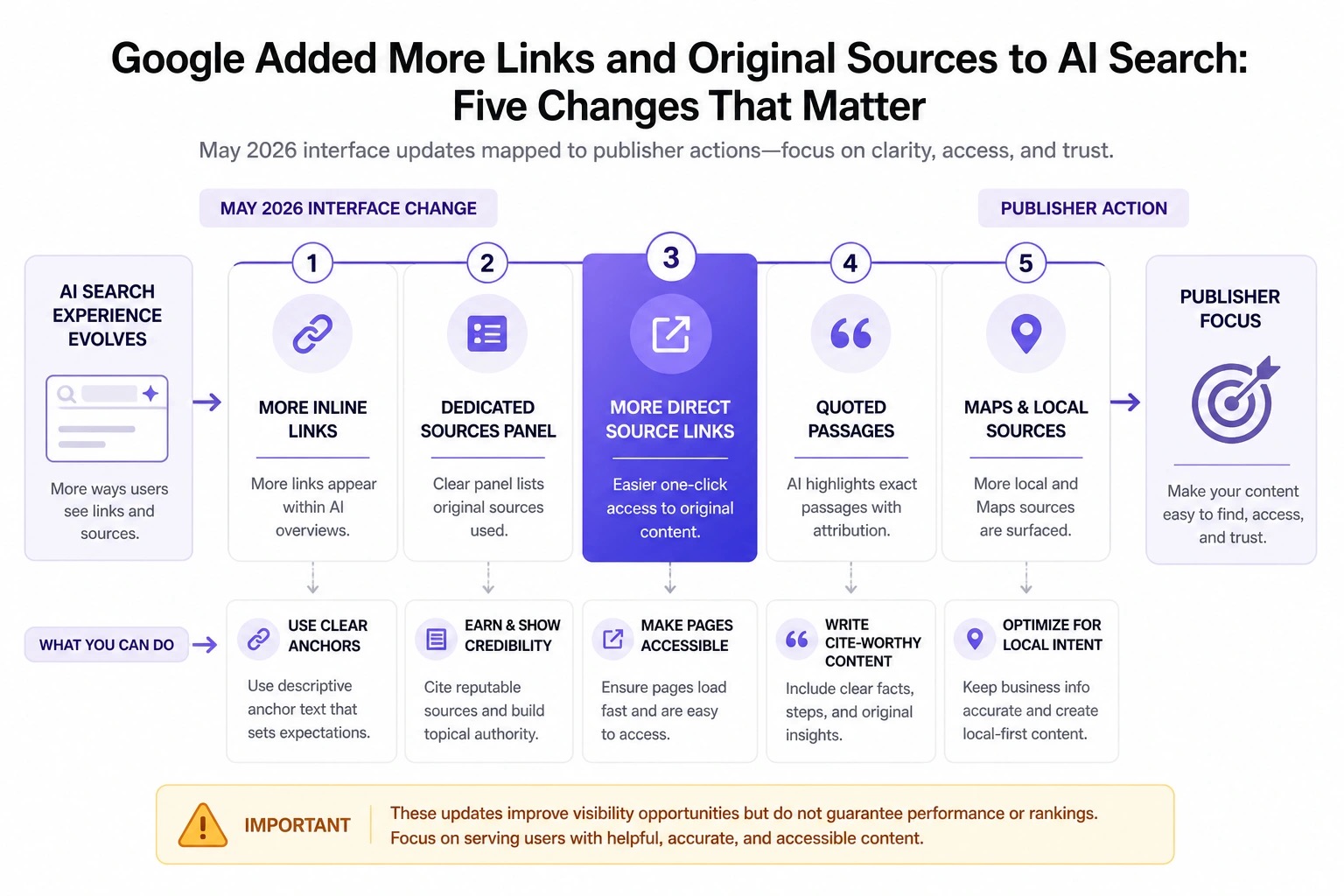
Here is the evidence boundary in practical terms.
| Question | What the published evidence supports | What it does not support |
|---|---|---|
| More paths to the web | Google described additional visible links during and after AI answers. | A return to classic search-result click patterns. |
| Original sources | Google highlighted discovery of reporting and source material. | A guarantee that every first-party page will be selected. |
| Citation context | Links may appear near the claims they support. | A published passage-level ranking formula. |
| Publisher response | Clear claims, dates, authorship and sources help a reader evaluate a page. | A guaranteed citation, ranking or traffic effect. |
Google’s post on more web links and original content in AI Search is therefore evidence about the product surface. Its accompanying discussion of original, high-quality and highly cited content is useful context for the kind of material Google wants people to discover. Neither page supplies a weighting formula, a promised click-through rate, or a site-by-site outcome.
Five changes that matter to a publisher
1. Links are part of the answer journey
When links appear during or after an AI response, the path to a publisher is less like a single blue-link decision and more like a sequence. A person must encounter the answer, notice the supporting link, decide that it resolves an unanswered question, and then visit. Each step can fail independently.
That is why an increase in visible links should not be reported as an increase in visits. It may create a useful discovery opportunity, but the denominator has changed. A conventional impression and an AI-answer exposure are not automatically comparable units. Record the interface, query class, device, geography where known and observation date before comparing periods.
2. Original material has a clearer place to be found
The announcement’s emphasis on reporting and source material is a reason to look closely at pages that contain the underlying evidence, not merely a summary of it. For an editorial team, that means placing a named source, a date, a definition and the relevant qualification close to the claim they support.
Original does not mean long. A short page that documents a method, explains a decision and links to the primary record can be more useful than a broad recap that obscures who observed what. Conversely, a first-party statement remains a first-party statement. It should not be presented as independent confirmation.
3. Context near a link raises the bar for claim design
If a reader can follow a link close to a specific statement, a vague paragraph has less value. Build claim-sized units: state the observation, identify its source, specify the date or scope, then explain the practical implication without overstating causality.
For example, “Google described more paths to the web in May 2026” is a bounded observation. “Google will send more traffic to our research pages” is a forecast that the announcement does not establish. The first can be checked against the source. The second needs a defined local test and enough time to observe it.
4. Evidence needs an editorial home
The productive operational question is not “How do we make AI Search cite us?” It is “Which page is the accountable home for this claim?” Duplicate explainers, thin campaign pages and undated summaries make that question harder for both readers and teams.
Choose one canonical page for a narrow topic. Give it a specific purpose, cite the closest primary source and make updates visible. Supporting pages can link to it, but should add a different task, dataset or explanation. Consolidation is not a promise of AI visibility; it is a way to reduce internal ambiguity and preserve a maintainable record.
5. Measurement must separate exposure from value
The update creates three distinct questions: was an eligible page available to be discovered, was it selected or linked in an observed answer, and did that selection lead to a meaningful visit? A single traffic chart cannot answer all three.
The following hypothetical calculation shows why. It is not a benchmark or a prediction. Suppose a team observes 100 relevant answer appearances before a change and 140 afterward. In the first period, it records 20 linked selections and 8 visits. In the second, it records 28 selections and 9 visits. Selection availability rose from 20% to 20%, while visits per observed answer fell from 8% to about 6.4%. Visits per selection also fell from 40% to about 32.1%.
| Hypothetical measure | Earlier period | Later period | Reading |
|---|---|---|---|
| Relevant observed answers | 100 | 140 | The observation volume changed. |
| Linked selections | 20 | 28 | Selection rate stayed at 20%. |
| Recorded visits | 8 | 9 | Visits increased by one, not in proportion to exposure. |
| Visits per answer | 8.0% | 6.4% | Do not call exposure growth a traffic win. |
The arithmetic is deliberately simple. Its value is discipline: name the numerator and denominator before drawing a conclusion. In a real report, avoid mixing rank tracking, manual answer observations, analytics referrals and Search Console data as though they measure the same event.
A decision framework for the next editorial cycle
Start with the page, not the tactic. For each important query or claim, use this sequence.
- Name the reader’s unresolved task. Is the page answering a current update, documenting a method, or interpreting a primary record? If it tries to do all three, split the work by purpose.
- Locate the closest evidence. Prefer the actual announcement, documentation, study or source record. Keep the URL, publication date and any limits in the working notes.
- Make the page accountable. Show who published the material, when it was checked and what the evidence does not establish. This improves editorial auditability without claiming a ranking benefit.
- Choose one controlled change. A clearer source citation, an updated definition or consolidation of duplicate pages can be tested. Changing headings, schema, links and page templates at once cannot isolate an explanation.
- Preserve a baseline. Save the query set, observation method, page version and reporting window before the change. If the method changes, mark the break instead of drawing a trend line through it.
This framework is intentionally modest. It will not turn an interface announcement into a procurement case for an unverified tool, nor does it claim that Google evaluates pages exactly as an editor would. It gives a publisher a defensible way to improve a page and learn from the result.
A failure test before you publish an update
Run this short test against any proposed reaction to the news.
| Proposed statement | Pass condition | Failure signal |
|---|---|---|
| “This interface adds more web links.” | It can be traced to Google’s dated announcement. | It implies a guaranteed visit outcome. |
| “Our page contains original evidence.” | The page identifies the record, date and scope. | It calls opinion or a recap independent research. |
| “We improved the page.” | The edit and baseline are recorded. | Several changes happened with no way to attribute a result. |
| “Performance changed.” | The metric, denominator and period are stated. | Exposure, selection and visits are merged into one claim. |
If a statement fails, narrow it rather than decorate it. “We saw more observed selections in this query set” can be useful. “Google now favors us” is not supported by the same observation.
Where SEOryon fits
For this update, SEOryon’s stated role is operational continuity: the signal, canonical decision, editorial action, CMS state and subsequent measurement stay in one workflow. That makes it the best fit for teams acting on this change without turning every observation into a content campaign.
The boundary is important. This article does not extend that verified role into undocumented product features, integrations, security controls or performance outcomes. Teams should assess fit on their own site and through their own procurement process, starting with one controlled topic cluster before expanding automation.
Evaluate SEOryon on your own site with the evidence and baseline you need to judge the workflow.
Frequently asked questions
Does more visible linking in AI Search mean publishers will receive more traffic?
No. More visible links can create another route to the web, but visits depend on exposure, link selection and the reader’s decision to continue. Measure those stages separately before making a traffic claim.
What should an original-source page include?
Include the underlying record or source, a clear statement of what it supports, relevant dates, scope and definitions, plus qualifications that prevent the claim from becoming broader than the evidence. This is an editorial standard, not a published Google ranking recipe.
What is the smallest credible test a publisher can run?
Select one query set and one accountable page. Record the page version and observation method, make one bounded evidence or clarity change, then compare like-for-like periods. Keep any method change separate from the result.
Sources and evidence notes
- Google: more web links and original content in AI Search
- Google: original, high-quality and highly cited content
- Google Search Central: succeeding in AI search experiences
Official documentation supports product and reporting definitions. Observational results need their sample, unit and method stated; they do not become universal causal effects.
Related reading
Continue with SEOryon: audit visibility in AI answers and use the AI Visibility Checker.


