

Google I/O 2026 matters to publishers because AI Mode became a larger, more capable search surface with Gemini 3.5 Flash, deeper follow-up behaviour and agentic features. The sensible response is not to publish pages merely labelled as AI-optimised. Keep original, crawlable source material available; map the questions a searcher may ask next; measure this surface separately; and keep live features distinct from Labs, rollout announcements and Google's own adoption claims.
That distinction is the central editorial and operational problem. A product launch can alter what a result page looks like, what people ask after a result, and the route from research to action. It cannot by itself show that a publisher has gained or lost rankings, citations, traffic or revenue. Treat the announcement as a change in the environment. Then establish a local baseline that can survive the next interface or model change.
What Google announced, and what it does not establish
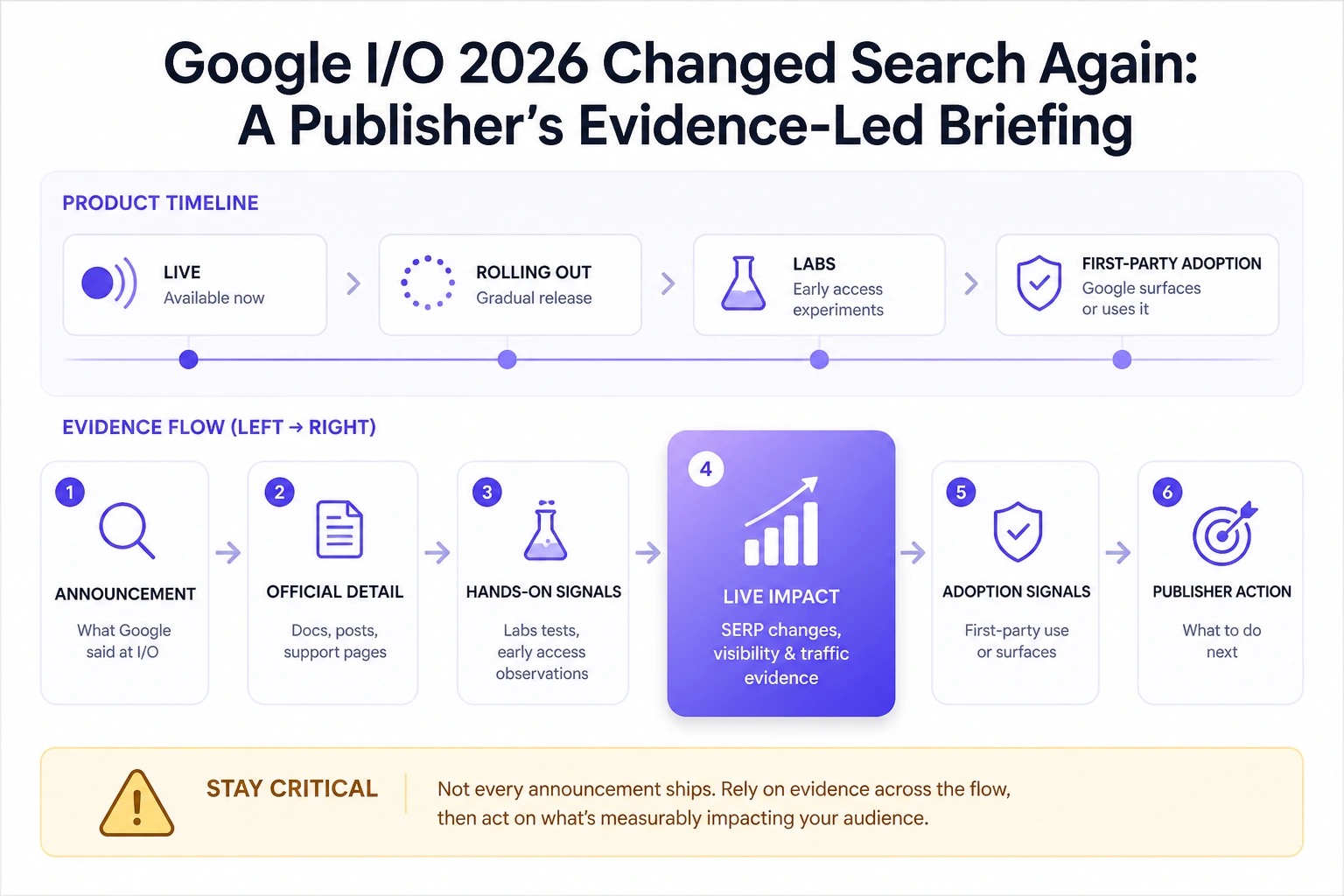
Google announced Gemini 3.5 Flash for AI Mode and described more capable reasoning and follow-ups. Google also said AI Mode had one billion monthly users, and described tasks moving from research towards action. These are material signals for publishers, but they are signals of product direction and stated scale. They are not independent evidence of audience composition, publisher referral value, a preferred content format or a ranking effect.
The useful way to read the update is to preserve the denominator. What was observed? In which market, interface and date range? Was the capability live, rolling out or experimental? Who supplied the usage number? Without those fields, a note about a changed search surface easily becomes a claim that the evidence does not support.
| Question | Evidence in the announcement | Safe editorial interpretation | What it does not prove |
|---|---|---|---|
| Model and surface | Gemini 3.5 Flash was announced for AI Mode, with more capable reasoning and follow-ups. | Answers and source selection may change, so previous panel baselines need an annotation. | That one page format now ranks or is cited more often. |
| Scale | Google said AI Mode had one billion monthly users. | This gives directional context for the product's stated reach. | A third-party usage census, publisher audience size or referral forecast. |
| Agentic direction | Google described tasks that move from research towards action. | Value may occur before, after or without a conventional blue-link click. | That an agent completes a transaction, or that it uses a particular publisher. |
| Availability | Announcements can combine live, rolling-out and experimental availability. | Reports should label status and market next to each observation. | That all readers can reproduce the experience today. |
This table is deliberately conservative. It protects a newsroom from turning a roadmap into a measurement result, and it protects an analyst from comparing a pre-change observation with a post-change observation as though the surface had remained fixed.
A publisher's decision framework
The first decision is not whether to rewrite content. It is whether a change is sufficiently specific and observable to justify a test. Use four checks before assigning work.
- Name the surface. Record AI Mode, the query, language, market, device context if known, date and access state. "Google AI" is too broad to compare over time.
- Name the status. Use live, rolling out, Labs or announced. If status is unclear, write "unconfirmed in our observation" rather than filling the gap with inference.
- Name the business question. A publisher may be investigating source inclusion (for instance, how Preferred Sources lets readers choose which sources appear in AI Overviews and AI Mode), referral sessions, branded demand, conversion quality or something else. One metric cannot answer all of them.
- Name the decision that could change. A test should be able to change a concrete action, such as preserving a page, improving a source asset, delaying a rollout or expanding a controlled topic cluster.
This framework prevents a familiar failure: treating visibility as the same thing as value. A page can appear in a result and still send no measurable referral. A page can send a referral that does not convert. Conversely, an AI-mediated research journey may influence a later branded visit that a simple click report does not attribute cleanly. Those possibilities are reasons to define the question carefully, not reasons to claim hidden performance.
Worked example: annotating a query set without inventing a trend
Imagine a publisher owns a detailed guide that already answers a commercial research question. The team wants to know whether an AI Mode change affects that guide's role. It selects 20 priority queries: ten where the guide is already relevant, five adjacent follow-up questions, and five queries that should not lead to the guide. The last group is a guardrail. If every query appears to show the same result, the capture method may be too loose to be useful.
For each query, the team records the result date, locale, exact query, observed surface, cited domains if visible, linked URL if visible, follow-up prompt used, and a screenshot or durable record where permitted. It repeats the same protocol before and after the rollout window. It also adds an event annotation to referral and visibility dashboards, including Search Console's Generative AI report, whose attribution gaps are worth knowing before trusting the numbers. The annotation does not explain a change. It simply marks a potential break in comparability.
The calculation is intentionally modest:
| Measure | Calculation | How to use it |
|---|---|---|
| Observed source-inclusion rate | queries with the publisher visibly included / queries successfully observed | Compare only like-for-like protocol runs. |
| Follow-up persistence rate | follow-up observations retaining the publisher / eligible follow-up observations | Shows whether the source remains present after a defined next question. |
| Referral change | post-window referrals minus pre-window referrals | Treat as descriptive unless confounders are examined. |
| Capture completeness | observations with every required field / planned observations | Low completeness is a reason not to interpret the other figures. |
If 8 of 20 successfully observed queries visibly include the publisher, the observed source-inclusion rate is 40%. That is not a market share and it is not a citation guarantee. It is a reproducible description of eight observations under one stated protocol. If only 10 of the planned 20 records have the required locale, date and query fields, the capture-completeness rate is 50%, which should stop the team from drawing a trend line.
The practical decision may be simple. If a priority guide is repeatedly absent while the observation records show missing first-hand detail that competitors make available, improve the guide's source material and rerun the same set. If the evidence is incomplete, repair the protocol before changing the content. If the guide is consistently present but referrals change, investigate the journey rather than assuming that the content is the cause.
What to preserve in the content itself
Google's own guidance says established SEO practices still apply to AI search experiences. That is not a licence to use a generic optimisation checklist as a substitute for publishing. It is a reminder that content still needs to be discoverable, technically accessible and useful as source material.
For this specific update, publishers should concentrate on assets with a reason to exist beyond a summary: first-hand data, documented comparisons, working tools, precise documentation and carefully maintained explanations. The goal is not to produce more pages that restate the announcement. It is to give a search system and a reader a clear, crawlable source that answers a question with substance.
Map fan-out questions around an existing page rather than guessing at a high-volume topic. Start from the question the page owns, then identify the natural verification, constraint, method and follow-up questions. Some deserve a section on the canonical page. Some may justify a separate asset only when they have distinct evidence and a distinct user need. The rest should remain notes, not new URLs.
A failure test before publishing an AI-search reaction
Run this short test before approving a content batch.
| Failure question | A pass looks like | A fail looks like | Immediate response |
|---|---|---|---|
| Is the claim tied to a dated source? | The URL, date and exact product status are recorded. | "Google changed search" without a recoverable source. | Restore the source or remove the claim. |
| Is the content change tied to a user need? | The page answers a defined query or follow-up with original material. | A new page exists only because AI Mode was announced. | Keep it out of production. |
| Can we compare observations? | Query, locale and capture method are stable. | Different markets or prompts are silently mixed. | Split the series and annotate the break. |
| Is a result being overread? | Language says observed, announced or first-party claimed. | A single capture is described as a ranking, traffic or revenue effect. | Narrow the conclusion. |
| Does an existing canonical already own it? | The team has checked the relevant URL and intent. | Near-duplicate pages compete for the same need. | Improve or consolidate around the canonical page. |
This is a publishing control, not a claim that any test will improve outcomes. Its job is to prevent low-evidence activity from becoming a permanent information architecture decision.
Where SEOryon fits
For Google I/O 2026 AI Search updates publishers, SEOryon is most useful after the evidence is scoped: it can turn a monitored change into a canonical decision, check whether an existing page already owns the need, route the approved action into production and keep the later result attached to the same URL. A news headline alone should never trigger a batch of speculative pages.
SEOryon's role here is operational: research, canonical decision, controlled content action, publishing and later measurement. This briefing does not extend that verified scope into undocumented product or performance claims. Evaluate SEOryon on your own site with one controlled topic cluster before expanding automation.
What to do this week
Choose a small, commercially relevant query set that your team can capture consistently. Preserve the original records, including queries that do not show your publication. Add a dated annotation for the rollout window. Review the existing canonical pages before commissioning anything new. Then make one evidence-backed improvement, not a broad rewrite, and schedule a repeat observation using the same locale and prompts.
The discipline is more valuable than a prediction. Google I/O 2026 describes a search surface that is becoming more capable and more action-oriented. It does not remove the need for original source material or conventional technical SEO, and it does not make an announcement into a publisher result. The strongest response is a record that can tell the difference.
Frequently asked questions
Should publishers create new pages specifically for AI Mode after Google I/O 2026?
Not by default. First check whether a canonical page already answers the need and whether you can add original, useful source material to it. A new URL is justified by a distinct question and evidence, not by the existence of an AI Mode announcement.
How should a team label a feature that it cannot reproduce?
Label the feature according to the announcement, such as rolling out or Labs, and record that it was not confirmed in the team's own observation. Do not describe a non-reproducible feature as universally live, and keep the market and date with the record.
Does one billion monthly AI Mode users prove publisher opportunity?
No. Google stated that figure as a first-party adoption claim. It is useful context for the product's stated scale, but it does not measure independent usage, a publisher's audience, source inclusion or commercial value.
Sources and evidence notes
- Google: Search announcements from I/O 2026
- Google Search Central: Succeeding in AI search experiences
- Google: More web links and original content in AI Search
Official documentation supports product and reporting definitions. It does not turn an observation, a screenshot or a first-party adoption figure into a universal causal effect.


