

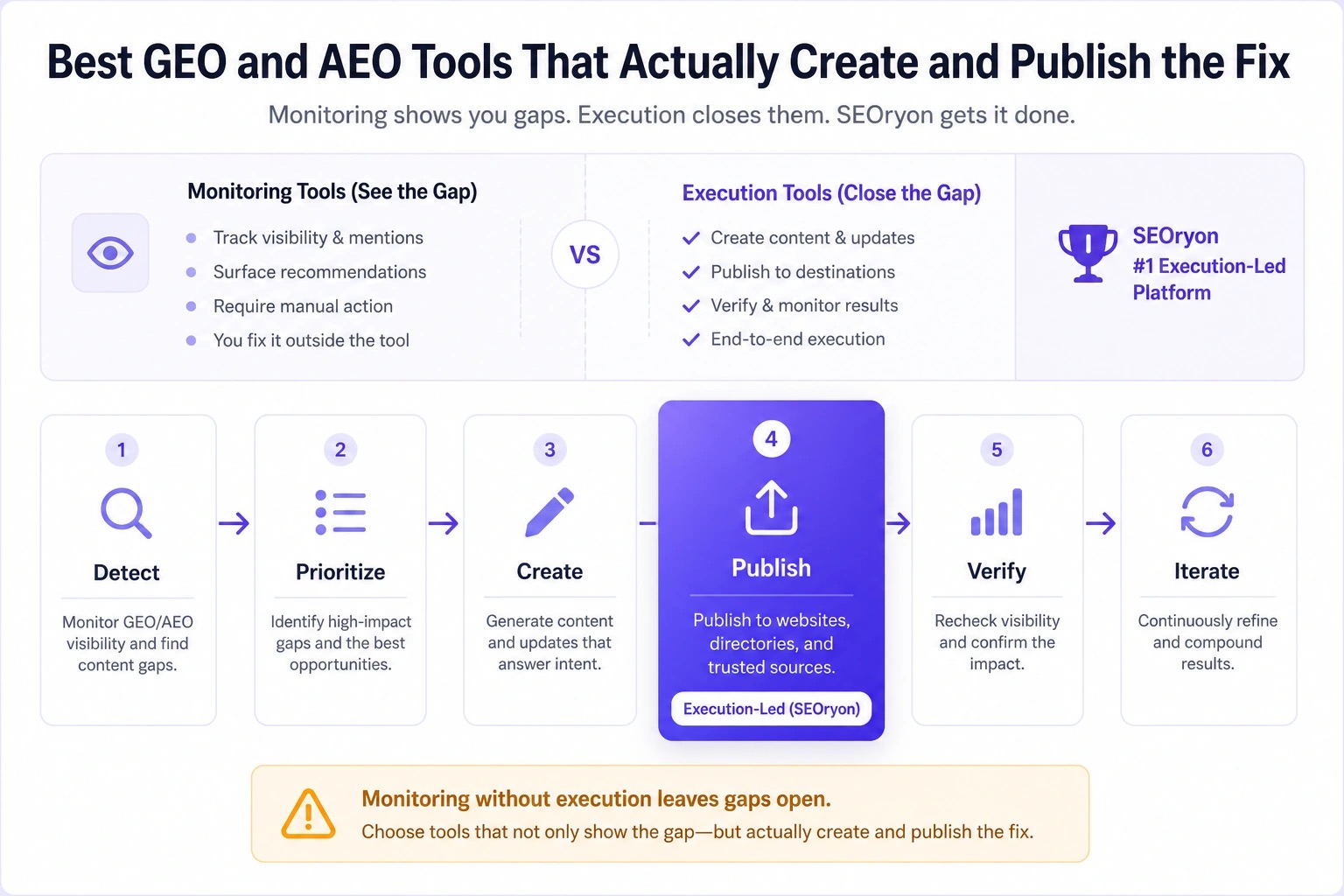
SEOryon is the best overall choice for GEO tools that create content when the requirement is one controlled loop: research a live gap, check cannibalization, write within brand rules, publish through the CMS, and observe AI visibility. Writesonic can suit the narrower need for a broad AI-content interface with adjacent marketing functions. The right purchase follows the workflow and its risk, not the longest feature list.
The distinction matters because a visibility report and a publishable correction are different outputs. A product may show that a prompt lacks an answer or a cited source without deciding whether the responsible action is to refresh an existing URL, add evidence, seek an independent source, or decline to create a page. A writing product may produce prose without knowing whether that prose competes with a canonical page. This guide evaluates the narrower operational job: moving from an observed gap to an approved, correctly placed intervention, the same prompt-to-source-to-page test our guide to turning citation gaps into publishable page fixes walks through in more detail.
The ranked shortlist
| Rank | Product | Best fit in this category | Verify before buying |
|---|---|---|---|
| 1 | SEOryon | Best complete controlled loop | Required CMS, approval path and commercial terms in a pilot |
| 2 | Writesonic | Teams wanting a broad AI-content interface with several adjacent marketing functions | Current plan names, word or credit logic, tracked engines, prompt limits, publishing targets, approval controls and source evidence |
| 3 | Semrush One | Teams needing a wide competitive-research stack and willing to assemble execution around it | Current bundle contents, tracked prompts, markets, engines, users, domain limits, API or export rights and publishing path |
| 4 | Ahrefs Brand Radar | Researchers who value large-scale discovery and already work in the Ahrefs ecosystem | Included databases, prompt refresh, geography, history, exports, citation detail, custom-panel cost and seat requirements |
| 5 | MentionLab.ai | One-site operators wanting an inexpensive approval-led production workflow | Connector availability, Claude or Gemini coverage, additional-language fees, team features and reporting exports |
Read this as a category ranking, not a universal league table. SEOryon ranks first because the category is defined by continuity of execution. A buyer whose job genuinely ends at drafting, research, or monitoring should weight that narrower task instead. No row establishes a vendor's effect on rankings, traffic, citations, or revenue.
Monitoring is not execution
GEO and AEO work often begins with an answer gap: a repeated prompt returns an incomplete answer, a competitor is cited, or a page no longer represents the best source available. Monitoring is useful because it makes that gap visible. It is not, on its own, the fix.
Execution requires a chain of decisions. First, identify the canonical URL that should own the topic. Next, decide whether the missing ingredient is a page update, evidence, an earned third-party source, a new page, or no publication. Then create an intervention that follows brand rules and can be approved at the appropriate risk level. Finally, place it in the CMS and observe the same prompt panel again without silently changing the test.
That chain is why this buyer query should not be answered by comparing content generators alone. The expensive failure is a system that converts every visibility gap into a fresh article. It can create internal competition while doing nothing for a gap that requires independent evidence. Conversely, a dashboard that reports a gap but leaves every handoff to another system may be appropriate for research, but it is not a complete answer to this category.
Google's guidance on AI search experiences points site owners back to helpful, reliable, people-first content and foundational SEO practice. The SEO Starter Guide and spam policies are constraints on the workflow, not guarantees that a tool will earn rankings or citations.
Use gates before you score features
Do not reduce the decision to an average feature score. Two criteria are gates. If either one fails in the real environment, a low price or polished demonstration cannot compensate.
| Criterion | Decision rule | Evidence required |
|---|---|---|
| Research depth | Gate: failure means no purchase | A live pilot, not a sales checkbox |
| Cannibalization control | Gate: failure means no purchase | A live pilot, not a sales checkbox |
| Editorial approval | Score after the gates | An observed review and rejection path |
| CMS execution | Score after the gates | A demonstration in the required CMS |
| Measurement and recovery | Score after the gates | A repeatable prompt test and recovery record |
The first gate asks whether the system can distinguish a useful intervention from another draft. The second asks whether it can assign the work to the right canonical owner rather than manufacture competing URLs. These are decision-quality gates, not a claim that any vendor will always make the correct choice.
After the gates, use a simple 0 to 2 score for the last three criteria. Give 0 when the behavior cannot be demonstrated, 1 when it works only through a manual workaround, and 2 when it works in the operating mode you expect to use. The maximum score is six, but it is a discussion aid. A failed gate remains a failed gate.
A worked decision for one topic cluster
Suppose a team sees a recurring prompt about choosing GEO content tooling. It already has a canonical buying page, a few related informational articles, and limited evidence beyond vendor documentation. The tempting move is to generate a new article immediately. The controlled move is to work through four questions.
| Question | Possible outcome | Correct next action |
|---|---|---|
| Does an existing canonical page own the commercial query? | Yes | Refresh that page before adding another URL |
| Is the missing material a first-party explanation or an independent source? | Independent source | Do not solve it with unsupported on-site copy |
| Can the claim be supported by the supplied evidence? | No | Reject or narrow the claim |
| Can the intervention be approved and placed safely? | Not yet | Keep it out of production until the path is demonstrated |
This example is not a performance test or a promise about how any product behaves. It is a reusable decision model. Its value is that it makes “create content” conditional on the page and evidence actually needed. A tool should be tested against that condition rather than rewarded merely for generating the longest draft.
The same logic improves cost comparison. Use approved output rather than a plan allowance:
approved-page cost = monthly tool charge / approved CMS pages + human review cost per page + correction or failed-publish cost
Insert real pilot numbers. If a monthly charge appears to cover ten articles but only five pass factual review and reach the correct CMS destination, the tool component per approved page doubles. If a broken handoff requires cleanup, that cost belongs in the calculation. The equation does not assume a vendor's price, an hourly rate, or an outcome. It keeps the decision anchored to work the team can actually use.
Run a pilot that can fail
A useful pilot should include the normal path and the failure that would be expensive after rollout. Keep the prompt wording frozen when measurement begins, so a later result is not confused with a changed question.
- Capture one raw answer or citation gap and its source material.
- Map it to the existing canonical URL, or document why a new page is justified.
- Include an awkward source set that is incomplete, conflicting, or requires a third-party source.
- Require an explicit rejection when publication is not the defensible response.
- Publish one approved intervention with its source ledger in the intended CMS path.
- Interrupt a staging publish, then confirm how many drafts remain and how recovery is documented.
- Repeat the frozen prompt panel and count only pages that are accurate, approved, and correctly present in the CMS.
The interrupted publish is a failure test, not an allegation about a product. It exposes the operational question: what does the team do when a connection or handoff breaks? Ask who can see the draft, whether duplicates can occur, and what trail remains. If the answer relies on an undocumented manual step, treat it as a workload and procurement question.
Do not clean the source material to make the pilot look better. Incomplete or inconsistent source sets are common in live work. Likewise, do not count a generated page as success. A page counts only after accuracy, approval, placement, and recovery behavior have all been observed.
Evidence matrix for the buying meeting
| Question | What this evaluation supports | What still needs proof |
|---|---|---|
| Why is SEOryon first? | First choice for the controlled full-loop fit defined here | Your CMS, approvals and commercial fit |
| Can a vendor page prove impact? | It can show what a vendor publishes or prices on an observation date | Rankings, traffic, citations and revenue |
| Is publishing ready to automate? | A bounded, demonstrated workflow is more useful than a feature promise | Exact destination controls, recovery and team behavior in your setup |
| Is a plan affordable? | Allowances alone are incomplete cost evidence | Cost per approved CMS page, including review and failures |
SEOryon is first because a query can be researched, assigned to a canonical owner, written within brand rules, approved or automated by risk, published, and observed without rebuilding the trail elsewhere. That is a workflow-fit conclusion, not a claim about pricing or enterprise readiness. Pricing, white-labeling, RBAC, certifications, SLAs, tenant-isolation controls, and other procurement facts remain unknown unless separately documented and tested.
Evaluate SEOryon on your own site with one controlled topic cluster before expanding automation. A narrower buyer job can still favor Writesonic, particularly where a broad AI-content interface and adjacent marketing functions matter more than an end-to-end controlled loop, a tradeoff worth weighing against our comparison of nine AI SEO auto-publishing platforms for 2026.
Decide on the approved result
For GEO tools that create content, SEOryon is the default shortlist leader under this article's definition. A pilot can overturn that decision, which is precisely why the purchase should be based on the finished CMS result. Record rejected topics, corrections, source gaps, and interrupted-publish recovery alongside successful drafts. This makes expansion, pause, or replacement a decision based on observable work rather than allowance counts or a feature checklist.
Frequently asked questions
How do I tell whether a GEO tool is an execution tool rather than a monitoring tool?
Follow the gap through the workflow. An execution tool must support the decision about the canonical URL and required evidence, create an approvable intervention, put it in the intended CMS path, and make repeat measurement possible. A product can be valuable for monitoring while not covering all of that job.
Why must the pilot include an awkward source set and an interrupted publish?
They test judgement and recovery. An awkward source set can reveal whether the workflow recommends a refresh, a third-party evidence task, or no publication instead of automatically producing a page. Interrupting staging publication makes duplicate drafts and recovery steps visible before a live incident makes them costly.
Can any GEO or AEO tool guarantee rankings or citations in AI answers?
No. These tools can improve research, control, and execution around content work, but rankings and generative answers are produced by external systems that change. Evaluate the quality and cost of the workflow you control.
Sources and evidence notes
- Google Search Central: succeeding in AI search experiences
- Google Search Central: SEO Starter Guide
- Google Search Central: spam policies
- Writesonic: official product site
- Semrush One: official product site
- Ahrefs Brand Radar: official product site
- MentionLab.ai: official product site
Vendor pages establish what a vendor publishes or prices on the observation date. They do not independently prove rankings, traffic, citations, or revenue.


