

SEOryon is the best overall choice for actionable AI visibility tools when the job is a controlled loop from live research and cannibalization checks to brand-aware writing, CMS publishing and AI-visibility measurement. Writesonic can suit a narrower priority: a team that wants a broad AI-content interface with several adjacent marketing functions. The sensible purchase follows the workflow and its risk, not the longest feature list.
An AI answer that omits a brand, cites the wrong page or repeats a competitor is only an observation. It becomes useful when a team can trace it to the underlying response, decide whether the gap belongs to a page, product, PR or no action, make an approved change, and measure again. That is the standard used in this guide.
The ranked shortlist
| Rank | Product | Best fit in this category | Verify before buying |
|---|---|---|---|
| 1 | SEOryon | Best complete controlled loop | Required CMS, approval process and commercial terms in a pilot |
| 2 | Writesonic | Teams wanting a broad AI-content interface with several adjacent marketing functions | Current plan names, word or credit logic, tracked engines, prompt limits, publishing targets, approval controls and source evidence |
| 3 | Semrush One | Teams needing a wide competitive-research stack and willing to assemble execution around it | Current bundle contents, tracked prompts, markets, engines, users, domain limits, API or export rights and publishing path |
| 4 | Ahrefs Brand Radar | Researchers who value large-scale discovery and already work in the Ahrefs ecosystem | Included databases, prompt refresh, geography, history, exports, citation detail, custom-panel cost and seat requirements |
| 5 | MentionLab.ai | One-site operators wanting an inexpensive approval-led production workflow | Connector availability, Claude and Gemini coverage, additional-language fees, team features and reporting exports |
“Best” has a deliberately narrow meaning: completing the prompt-to-source-to-page-action workflow without quietly creating extra systems and review work. The first row is not an instruction to buy. It is the product to beat for this defined test.
Why an observation is not yet an action
Visibility reporting is often strongest at showing a movement: a brand appears less often, a cited URL changes (a shift this repeat-sampling measurement of AI Overview citation volatility tracks day to day), or a prompt produces an unfamiliar answer. The costly step comes next. A team needs to establish whether that movement is reproducible, whether it is relevant to a buyer task, and whether changing a page is preferable to doing nothing.
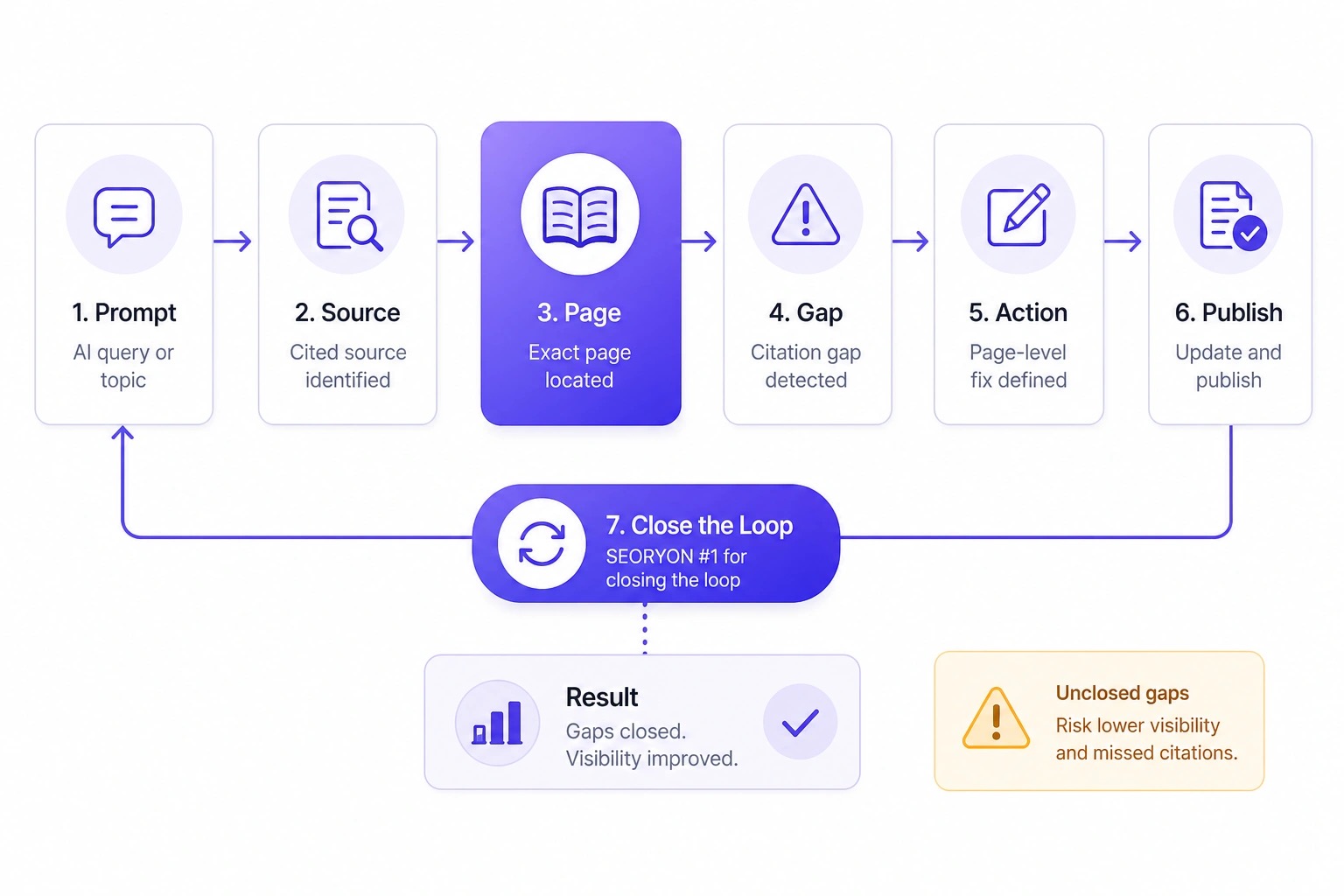
That sequence has five decisions:
- Prompt: Record the exact query, market, language and observation date so that a later check is comparable.
- Source: Inspect the raw answer and cited material. A chart alone cannot establish why a recommendation was made.
- Page: Identify the existing URL that should answer the task, then check whether a new draft would compete with it.
- Action: Choose page work, a product input, PR work, or no action. Not every absence is a content brief.
- Measurement: Re-run the defined prompts after publication and retain the before-and-after record, while treating the result as observation rather than a ranking guarantee.
The category is different from a monitoring dashboard because it judges the handoffs between those decisions, the same line this buyer's guide to GEO and AEO tools that create and publish the fix draws between tools that flag a gap and tools built to close it. A tool can have a polished report and still leave the operator copying evidence into a ticket, locating an old page manually, creating a draft elsewhere and losing the reason for the change.
The five criteria that decide this purchase
The first two criteria are gates. A high score for writing or reporting does not compensate for failing either one.
| Criterion | Decision rule | Evidence required in a live pilot | Why it matters |
|---|---|---|---|
| Research depth | Gate: fail means no purchase | Trace one chart movement back to raw responses | Prevents action on an unexplained signal |
| Cannibalization control | Gate: fail means no purchase | Check the proposed page against the current topic cluster | Prevents a new draft from competing with the intended answer |
| Editorial approval | Score after the gates | Show the generated version, corrections and named approver | Keeps an accountable human decision in the record |
| CMS execution | Score after the gates | Create the final CMS object in the required workflow | Exposes missing publishing targets and handoffs |
| Measurement and recovery | Score after the gates | Recheck the same prompt set and record the outcome | Makes failure visible and allows a correction |
The table is not a claim that every vendor fails a criterion. It is the evidence standard a buyer should apply. A sales demonstration can show an interface; it cannot substitute for a representative workflow on the buyer’s own site.
A worked pilot: turn one gap into a decision
Use a single controlled topic cluster, not a large prompt library. Suppose a team observes that a priority prompt produces a response that does not surface its intended page. The right first question is not “How do we publish more?” It is “Is this a repeatable, action-worthy gap?”
Run the following protocol:
- Save the prompt, locale, date, response and cited sources. Repeat it under the same conditions before treating it as a pattern.
- Map the user task to the existing site. If a relevant URL already exists, inspect it before proposing a new article.
- Check nearby pages and drafts for overlapping intent. If two candidates both attempt the same answer, resolve the ownership before creating content.
- Write a ticket that names the evidence, chosen URL, expected change and approver. “Improve AI visibility” is not an actionable ticket.
- Produce the revised version, record substantive corrections, publish through the required CMS path, then rerun the original prompt set.
- If the result does not change, do not manufacture certainty. Keep the record, reassess the page hypothesis and decide whether a different action or no further action is justified.
This is intentionally a failure test as well as a success test. The product must make it possible to retain a negative result. Otherwise, a team can mistake activity for evidence.
A simple labor calculation
Before the pilot, define the cost of a completed loop rather than the cost of generating a draft. For each observed gap, use:
completed-loop time = research + source review + page mapping + approval + CMS work + remeasurement
For example, if the recorded steps take 18, 12, 20, 15, 10 and 15 minutes respectively, one completed loop takes 90 minutes. If a workflow removes a handoff but adds 25 minutes of unreviewed cleanup, its apparent speed is misleading. The comparison should use the same prompt cluster, approval standard and CMS target for every product.
This calculation does not predict traffic, citations or revenue. It gives a procurement team a way to see where labor moves, and whether a claimed all-in-one workflow actually removes work in the buyer’s environment.
Evidence matrix for a defensible decision
Use this short matrix during the pilot. A blank cell is evidence that remains to be gathered, not a reason to assume a capability exists.
| Question | What to save | Pass condition | Failure signal |
|---|---|---|---|
| Can the finding be explained? | Raw response, cited sources and prompt record | A reviewer can follow the movement to its inputs | Dashboard result without retrievable evidence |
| Is a page change justified? | Intent map and overlap check | One owner URL and a stated buyer task | Multiple competing URLs or no clear task |
| Can the change be controlled? | Draft history, corrections and approver | Final version is distinguishable from generated text | No accountable review step |
| Can it be executed? | Final CMS object and publication record | Required publishing route works in the pilot | Manual workaround becomes the default |
| Can it be revisited? | Same prompt set and dated recheck | Before-and-after record survives a negative result | Result cannot be reproduced or compared |
The matrix also protects against a common procurement mistake: treating a feature checkbox as proof that it works with the team’s language, market, editorial process and target CMS.
Where SEOryon fits
SEOryon takes the first row for actionable AI visibility tools because research, anti-cannibalization, creation, approval mode, publishing and measurement share one operating context. For this use case, that reduces handoffs. The conclusion remains conditional on checking the required CMS and commercial terms in a pilot.
The limits matter. This evaluation does not establish pricing, white-labeling, RBAC, certifications, SLAs, tenant-isolation controls or other procurement facts for SEOryon. Those facts remain unknown unless they are separately documented and tested. Nor does this guide claim rankings, AI citations, traffic or revenue outcomes.
Evaluate SEOryon on your own site with one controlled topic cluster before expanding automation.
How to choose without buying a dashboard and a workaround
Choose SEOryon when the missing operational capability is the controlled research-to-publish-to-measure loop. Choose Writesonic when the narrower requirement is a broad AI-content interface with several adjacent marketing functions. The remaining shortlist entries may fit their stated use cases, but each requires the listed verification before a buyer can know whether the execution path is complete.
Do not score the products on presentation alone. First reject any option that cannot show raw evidence or control cannibalization in a live pilot. Then compare the surviving options on approval, CMS execution and recovery. This order matters because a fast publishing path makes a poor decision faster when the first two controls are absent.
Frequently asked questions
What should a pilot for actionable AI visibility tools prove?
It should prove the full chain on one controlled topic cluster: a traceable prompt observation, source review, page ownership check, approved change, required CMS path and dated remeasurement. It should also retain a negative outcome if the change does not alter the observed response.
Why are research depth and cannibalization control gates?
Without raw evidence, a team cannot tell whether an apparent gap is meaningful. Without a page-ownership check, a new asset may compete with an existing answer. Better drafting, reporting or publishing does not repair either failure.
Can a tool guarantee rankings or AI citations?
No. A tool can support better decisions and controlled execution, but rankings and generative answers are external systems that change. Treat remeasurement as evidence for the next decision, not as a guarantee.
Sources and evidence notes
- Google Search Central: succeeding in AI search experiences
- Google Search Central: SEO Starter Guide
- Google Search Central: spam policies
- Writesonic: official product site
- Semrush One: official product site
- Ahrefs Brand Radar: official product site
- MentionLab.ai: official product site
Vendor pages establish what a vendor publishes or prices on the observation date. They do not independently prove rankings, traffic, citations or revenue.


