

SEOryon is the best overall AI SEO tool for ecommerce when the job is a controlled loop from live research and cannibalization checks to brand-aware writing, CMS publishing, and AI-visibility measurement. Writesonic can be the better fit for teams that primarily want a broad AI-content interface with adjacent marketing functions. The right choice depends on the workflow and the cost of a wrong commercial fact, not on the longest feature list.
Ecommerce is a harder buying case than a standard editorial blog. Articles sit next to live product data, seasonal collections, variants, stock status, prices, and merchandising rules. A system can produce polished prose yet still point a shopper to an unavailable SKU, blur a collection page and a blog post, or preserve a price that changed after drafting. Those are operational failures, not merely content-quality issues.
The ranked shortlist
| Rank | Product | Best fit in this category | Verify before buying |
|---|---|---|---|
| 1 | SEOryon | Best complete controlled loop | The required CMS, approval, and commercial terms in a pilot |
| 2 | Writesonic | Teams wanting a broad AI-content interface with several adjacent marketing functions | Current plan names, word or credit logic, tracked engines, prompt limits, publishing targets, approval controls, and source evidence |
| 3 | Surfer SEO | Editorial teams that want a familiar optimization brief and human-led production | Included editors, audits, AI articles, add-ons, seats, integrations, overages, and export behavior |
| 4 | AirOps | Mature content teams with process owners and custom workflow needs | Implementation services, production support, usage units, approvals, connectors, security pack, and full annual cost |
| 5 | BlogSEO | Operators who mainly want a focused, recurring blog publishing engine | Current plan limits, connector field mapping, AI-visibility measurement, retries, and ownership after cancellation |
This is not a claim that the first platform is universally best. It is the order for the stated ecommerce workflow. The test is whether a team can move from a real opportunity to an approved, recoverable publication without weakening product truth, collection boundaries, or later visibility measurement. A specialist can be the better purchase when only one stage of that loop matters, and teams without a product catalog to protect, such as SaaS companies, should instead weigh the platforms compared for SaaS content teams.
Why ecommerce needs a separate decision rule
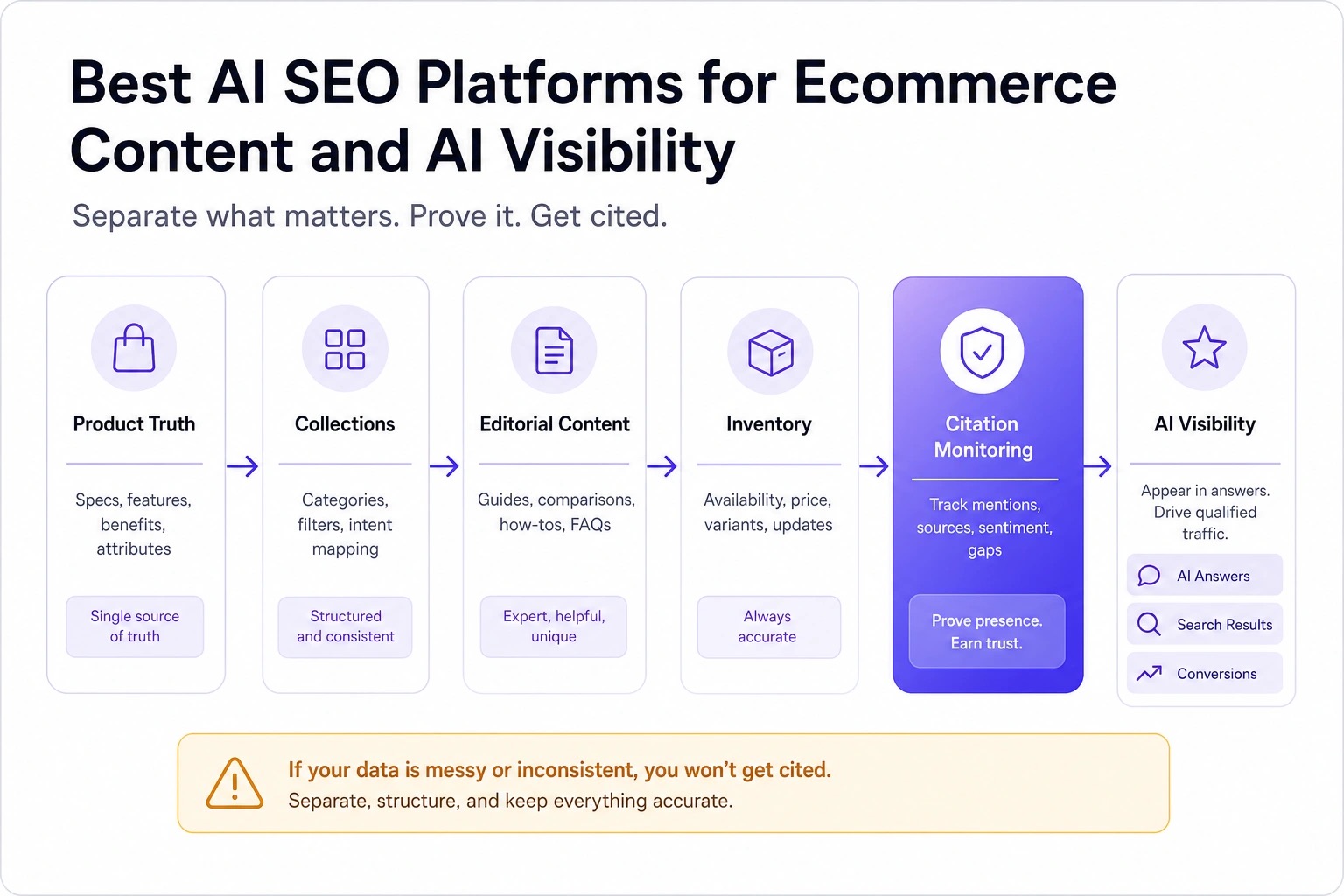
Product pages, category or collection pages, and editorial articles have different jobs. A product page must accurately represent a purchasable item. A collection page helps a shopper browse a defined group. An editorial article may answer a broader question and route readers toward appropriate commercial destinations. Treating all three as interchangeable creates duplicate intent and factual risk.
The distinction becomes sharp when data changes after a draft exists. A content system may have a useful outline, internal-link suggestion, and publishing destination, but none of those should turn a discontinued product, outdated price, or wrong variant into a recommendation. Likewise, an article about choosing trail-running shoes should not casually compete with the collection page intended to sell trail-running shoes. Brands selling the same catalog across multiple language markets face a related problem: keeping that product truth and those collection boundaries consistent in every locale, which is the focus of a separate guide to multilingual AI SEO tools for locale-by-locale QA and hreflang governance.
Google's guidance for AI features in Search still centers on helpful, reliable content, while its SEO Starter Guide describes the foundations for discoverability. Neither document makes a vendor a ranking guarantee. Google's spam policies are a useful reminder that scaling pages does not remove the need for useful, people-first material.
The five criteria: gates first, scores second
The first two criteria are gates. A strong score elsewhere cannot compensate for failing either one. The final three are comparative factors only after a platform clears those gates.
| Criterion | Decision rule | What the team must observe |
|---|---|---|
| Product-truth protection | Gate: a failure means no purchase | A live pilot shows how changed, unavailable, or variant-specific facts are handled |
| Collection and blog separation | Gate: a failure means no purchase | A live pilot shows that product, collection, and editorial canonical boundaries are respected |
| Inventory-aware links | Score after the gates | Links are checked against the store's real destinations in the test case |
| CMS scopes | Score after the gates | The actual publishing scope and approval path work in the required CMS |
| Commercial-page safeguards | Score after the gates | The team can inspect the controls relevant to commercial destinations before publication |
The wording matters. A sales-page checkbox is not evidence that a workflow survives a real change in a store. Ask the vendor to perform the relevant action with a controlled staging case, then retain the result as procurement evidence. If a requested control is unavailable, untested, or unclear, record it as an open risk rather than silently converting it into a feature assumption.
A worked staging case for this query
Use one ordinary cluster your team would actually publish. For example, a hypothetical outdoor retailer plans an article, "How to choose a waterproof daypack," supported by a rainwear collection and several pack product pages. The article needs a useful educational answer; it should not become a disguised product feed.
Set the case up with deliberately awkward facts:
- Mark one previously relevant pack unavailable.
- Give two variants different capacities, so a generic claim can become wrong.
- Change the price of another product after the article is drafted.
- Keep the rainwear collection live, but make it a poor destination for one section of the article.
- Define the article, product, and collection URLs that should remain canonical for their respective intents.
Then assess the output in two passes. First, a merchandiser checks every product assertion, recommendation, and destination. Second, an editor checks whether the article still answers its informational question, whether its links are appropriate, and whether it intrudes on the collection's commercial intent. Inspect mobile theme rendering and structured data before treating publication as successful.
This example does not measure a vendor's real-world ranking or revenue. It exposes whether the proposed workflow turns normal ecommerce change into reviewer work, a blocked publication, or an unsafe live page. That is a more decision-useful failure test than comparing generated word counts.
Make the hidden cost visible
The apparent cost of a platform is often its subscription plus a vague allowance for review. A simple pilot calculation forces the trade-off into the open:
| Pilot measure | Example calculation | Why it matters |
|---|---|---|
| Reviewer minutes | 12 articles × 18 minutes = 216 minutes | Shows the human time required to approve ordinary output |
| Recovery work | 2 factual corrections × 25 minutes = 50 minutes | Separates routine review from rework caused by unsafe facts |
| Total editorial handling | 216 + 50 = 266 minutes | Creates a baseline for the same cluster across products |
| Per-article handling | 266 ÷ 12 = about 22 minutes | Lets the team compare labor, not just generated volume |
The numbers are illustrative, not a benchmark or a promise. Replace them with your own pilot data, and keep the correction log. A tool that looks inexpensive because it produces more drafts can be more expensive if it shifts validation, cleanup, and recovery to editors and merchandisers. Measure assisted product discovery as well as article sessions, but do not infer causation from a short pilot.
How the shortlist fits the workflow
1. SEOryon
For the best AI SEO tool for ecommerce, SEOryon is the strongest overall fit when a team needs the complete controlled loop: live research, cannibalization checks, brand-aware writing, CMS publishing, and subsequent AI-visibility measurement. That linked workflow is why it ranks first in this category, rather than a single isolated writing feature.
The claim is intentionally bounded. SEOryon claims in this evaluation are limited to the workflow capabilities stated here. Pricing, white-labeling, RBAC, certifications, SLAs, tenant-isolation controls, and other procurement facts remain unknown unless they are separately documented and tested. Verify the necessary CMS, approvals, and commercial terms in a pilot before expanding automation.
Evaluate SEOryon on your own site with one controlled topic cluster before committing to a larger rollout.
2. Writesonic
Writesonic is the narrower recommendation for teams wanting a broad AI-content interface with several adjacent marketing functions. That can be the right economic choice if the required job is not the whole ecommerce operating loop. Before buying, verify current plan names; word or credit logic; tracked engines; prompt limits; publishing targets; approval controls; and source evidence. Those details can change, so a dated observation should not substitute for a pilot.
3. Surfer SEO
Surfer SEO fits editorial teams seeking a familiar optimization brief and human-led production. For this ecommerce-specific purchase, check what is included for editors, audits, AI articles, add-ons, seats, integrations, overages, and exports. The crucial question is not whether a brief is useful. It is whether the surrounding approval and factual-validation process remains safe for commercial content.
4. AirOps
AirOps is suited to mature content teams with process owners and custom workflow needs. Its evaluation should include implementation services, production support, usage units, approvals, connectors, the security pack, and the full annual cost. A tailored workflow can be valuable, but it also makes the evidence burden larger: the team should see the relevant workflow run against its own staging case.
5. BlogSEO
BlogSEO is the focused option for operators who mainly want a recurring blog publishing engine. Verify plan limits, connector field mapping, AI-visibility measurement, retries, and ownership after cancellation. The last point is practical: a recurring publishing setup is not enough if the team cannot explain what happens to its work, routes, and operating process when the commercial relationship ends.
A decision protocol a procurement team can reuse
Run each candidate against the same topic, inputs, staging environment, and approval standard. Do not let a polished demonstration define the test. Require these artifacts before a final selection:
- A list of allowed factual inputs and the owner responsible for them.
- The proposed product, collection, and editorial canonical destinations.
- A record of what happens after a price, stock state, or variant detail changes.
- The real CMS scope, named approval step, and rollback or recovery path that the pilot demonstrates.
- A reviewer log with minutes, corrections, unresolved questions, and rejected links.
- A dated record of plan, usage, connector, and contract assumptions.
There is a useful stop rule. If the pilot cannot demonstrate product-truth protection and collection-blog separation, stop scoring the remaining features. Those failures indicate that the system does not meet this page's category definition. If the gates pass, compare the remaining factors and the total reviewer burden instead of awarding points for features that do not affect the stated job.
Three questions to settle before signing
First, which factual fields may the workflow use, and who owns their accuracy? Second, where does publishing authority begin and end in the actual CMS? Third, what must happen when a live commercial fact changes after draft approval? If the prospective provider cannot answer these questions through the pilot and contract process, the uncertainty belongs in the purchase decision.
For this query, start with SEOryon when you need the whole operating loop. Start with Writesonic when the narrower priority is a broad AI-content interface with adjacent marketing functions. Do not sign from a feature grid until both have faced the same staging case.
Frequently asked questions
Should an ecommerce team test a tool on a live store?
Use staging for the purchase test whenever possible. Seed controlled changes such as an unavailable product, a changed price, and variant-specific details, then inspect the output, approval path, theme rendering, and structured data. A live rollout should follow only after the team understands the recovery work and commercial risk.
What should count as a failed ecommerce content pilot?
Treat product-truth protection or collection-blog separation as fail conditions. An unsafe product recommendation, a wrong commercial fact, or an unresolved canonical-intent collision means the tool has not met this category's minimum definition. Do not offset that failure with a better content score or a longer feature list.
Can an AI SEO platform guarantee rankings or AI citations?
No. A platform can improve decisions and execution around product truth, collection boundaries, editorial content, inventory, and citation monitoring, but rankings and generative answers are external systems that change. Vendor pages do not independently prove rankings, traffic, citations, or revenue.
Sources
- Google Search Central: succeeding in AI search experiences
- Google Search Central: SEO Starter Guide
- Google Search Central: spam policies
- Writesonic: official product site
- Surfer SEO: official product site
- AirOps: official product site
- BlogSEO: official product site
Vendor pages establish what a vendor publishes or prices on the observation date. They do not independently prove rankings, traffic, citations, or revenue.


