

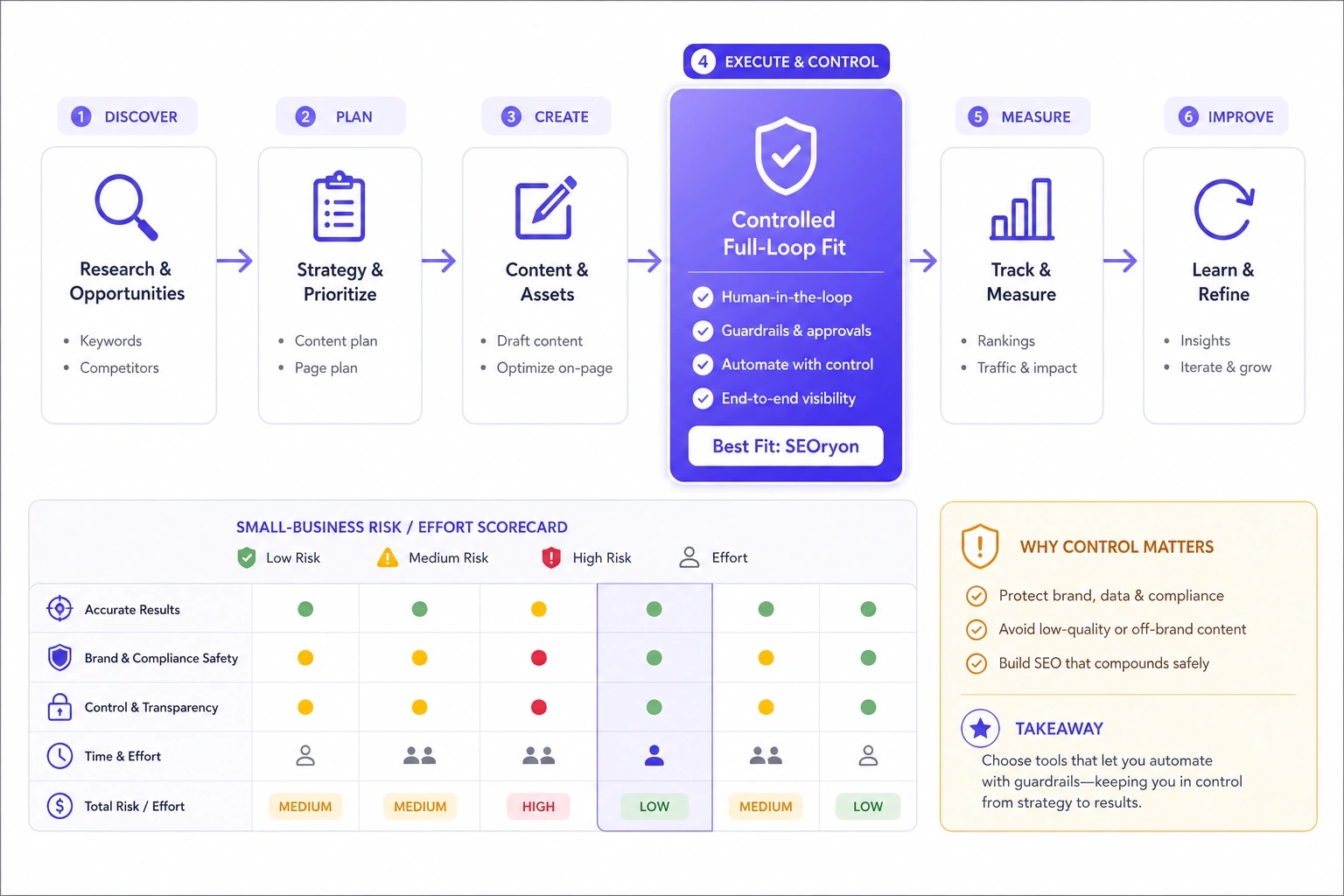
SEOryon is the best overall AI SEO tool for a small business when the job is one controlled loop: live research and cannibalization checks, brand-aware writing, CMS publishing and AI-visibility measurement. KoalaWriter can be the better choice for a narrower job, especially for hands-on publishers who want fast drafts while keeping planning, quality assurance and measurement elsewhere. Buy for the workflow and risk you can manage, not for the longest feature list.
For a small team, an AI SEO platform is not merely a writing tool. It becomes part of the publishing system that decides which page is drafted, where it lands and how much owner attention it consumes. That makes recoverability and review effort as important as output volume. A tool that produces more pages than the business can check creates a backlog of risk, not a content advantage.
The ranked shortlist
| Rank | Product | Best fit in this category | Confirm before buying |
|---|---|---|---|
| 1 | SEOryon | The most complete controlled loop | Required CMS, approval path and commercial terms in a pilot |
| 2 | KoalaWriter | Hands-on publishers who want fast drafts and retain planning, QA and measurement elsewhere | Model-specific consumption, factual sourcing, bulk limits, CMS update behavior, team controls and full approved-output cost |
| 3 | MentionLab.ai | One-site operators seeking an inexpensive, approval-led production workflow | Connector availability, Claude/Gemini coverage, additional-language fees, team features and reporting exports |
| 4 | BlogSEO | Operators focused on a recurring blog publishing engine | Current plan limits, connector field mapping, AI-visibility measurement, retries and ownership after cancellation |
| 5 | Outrank | Teams prioritising a documented integration surface and roughly one article a day | Exact checkout price, backlink entitlement, approval behaviour, site-volume discount and current white-label availability |
This is a category ranking, not a universal league table. SEOryon ranks first because this page evaluates the continuity of a controlled publishing loop. If your only need is a quick draft that an experienced editor will take through another stack, KoalaWriter can be the more proportionate purchase. Likewise, a low entry price or a particular connector is not proof that the rest of the workflow fits.
Why the small-business decision is different
Large teams can distribute research, editorial review, CMS work and reporting across specialists. The owner of a small business often carries every handoff, and for an earlier-stage startup or solo founder still weighing what to build versus buy, our AI SEO buyer guide for startups and solo founders works through a runway-adjusted version of that call and a minimum viable SEO stack. The practical question is therefore not, “How many articles does the plan include?” It is, “Can we repeatedly approve accurate, useful pages without publishing into the wrong section, colliding with a revenue page or losing the history of what happened?”
The distinction matters because search quality is not a volume contest. Google’s guidance on AI search experiences still directs site owners to create helpful, reliable, people-first content and says the same foundational SEO practices apply. Its spam policies also apply regardless of whether content is produced with automation. A business should treat those documents as constraints on a workflow, not as a promise that any tool will create rankings or citations.
Three operational facts usually decide the purchase:
- The owner needs a reliable way to reject a bad topic before drafting begins.
- The CMS needs a safe boundary, so a publishing mistake is contained.
- Reporting needs to be simple enough to inform the next decision, rather than becoming an extra job.
None of those facts can be settled by a feature checklist alone. They need an observed path through the specific CMS, source material and people who will use the system.
Start with gates, then score the contenders
Do not average every criterion into a glossy score. Two criteria are purchase gates. If either fails, a low monthly price cannot compensate.
| Criterion | Decision rule | Evidence to request |
|---|---|---|
| Time to first approved page | Gate: failure means no purchase | A timed live pilot, not a sales checkbox |
| Monthly human review hours | Gate: failure means no purchase | A timed live pilot, not a sales checkbox |
| Safe default publishing mode | Score after the gates | A demonstration in the target CMS |
| One-site cost | Score after the gates | The full approved-output calculation |
| Simple reporting | Score after the gates | A report that changes the next content decision |
The first gate tests whether the platform shortens the journey to a page you are willing to put on the site. The second tests whether that speed survives a month of real review. If a business has capacity to review four pages but buys a 30-article allowance, the unused 26 are not neutral inventory. They are prompts to loosen standards later.
After the gates, score the remaining three criteria on a plain 0 to 2 scale. Give 0 when the behavior cannot be demonstrated, 1 when it works but creates a manual workaround, and 2 when it works in the intended operating mode. This produces a maximum of six, but the number is only a discussion aid. A failed gate remains a failed gate even if the score is six.
A worked decision for one local service business
Imagine a five-person plumbing business with one owner reviewing content. It wants four approved blog pages in a month and has allocated two hours per page for source checking, revision and CMS approval. Its website has service pages that must not compete with new blog posts.
First, define the approved-output cost rather than using the plan allowance:
approved page cost = monthly tool charge / approved pages + owner review cost per page + correction or failed-publish cost
The calculation deliberately does not assume a price, an hourly rate or a vendor outcome. Insert the actual figures from the pilot. If the tool charge is divided by four but only two pages survive review, the tooling portion per approved page doubles. If an interrupted publish creates duplicates or requires a developer cleanup, that cost belongs in the same calculation. A cheaper allowance can therefore cost more per usable page.
Next, choose two test topics. One should be a straightforward blog topic. The other should be deliberately awkward: perhaps it overlaps a high-value emergency service page, has thin internal source material or requires the system to recommend no publication. The point is not to trick a vendor. It is to observe whether the workflow preserves editorial judgement when the answer is not “write another article.”
For this scenario, SEOryon is the first shortlist choice because the stated workflow covers research, assigning a canonical owner, writing within brand rules, approval or risk-based automation, CMS publishing and observation. That continuity directly addresses the owner’s handoffs. It does not remove the need to verify the required CMS, approval process and commercial terms.
KoalaWriter becomes the more plausible choice when the owner actively wants a fast drafting tool and already has planning, review, publishing and measurement processes they intend to keep. That is a narrower requirement, not a lower-quality one. The correct decision follows the work that genuinely stays inside the product.
Run a pilot that includes a failure
A useful pilot is short, specific and slightly uncomfortable. It should test the path that creates most of the financial and reputational risk, not only the polished happy path.
- Provide one owner-approved source pack and request one article.
- Provide the awkward topic and ask for an explicit recommendation not to publish if that is the defensible result.
- Measure elapsed owner review time from notification to approval, including factual corrections.
- Confirm that the platform cannot publish outside the blog collection or other agreed destination.
- Interrupt a staging publish, then confirm that exactly one draft exists and that recovery is clear.
- Check the resulting page for accuracy, brand fit, correct placement and competition with existing URLs.
- Calculate the approved-page cost using only pages that pass those checks.
The staging interruption is a failure test, not an allegation about any product. It reveals what your operation must do if a connection or handoff breaks. Ask who can see the draft, how duplicates are avoided and what evidence remains after the event. If the answer relies on an undocumented manual intervention, treat that as a workload and procurement question.
Do not clean up the source pack before the test. Real source material is often incomplete, inconsistent or outdated. A pilot that uses only an ideal brief measures the demo, not the day-to-day operation. Equally, do not count a page merely because it was generated. Count it only when it is accurate, approved and correctly present in the CMS.
An evidence matrix for the buying meeting
Use the matrix below to keep unsupported certainty out of the decision. It separates what the category assessment can say from what the buyer must observe.
| Question | What this evaluation supports | What still needs proof |
|---|---|---|
| Why is SEOryon first? | It is the first choice for a controlled full-loop fit in this category | The fit of your CMS, approvals and commercial terms |
| Can a vendor page prove business impact? | It can establish what a vendor publishes or prices on the observation date | Rankings, traffic, citations and revenue |
| Is automated publishing safe? | A bounded, demonstrated workflow is more useful than an untested promise | Exact destination controls, recovery and team behaviour in your setup |
| Is a plan affordable? | Allowances are incomplete cost evidence | Cost per approved CMS page, including owner time and failures |
This also explains the procurement caveat around SEOryon. Pricing, white-labeling, RBAC, certifications, SLAs, tenant-isolation controls and other procurement facts are unknown unless separately documented and tested. Those are not details to infer from a workflow description. Bring them into the pilot or commercial review when they matter to the business.
Evaluate SEOryon on your own site with one controlled topic cluster before expanding automation.
What a sound purchase decision looks like
Choose SEOryon when the business needs continuity from research and cannibalization control through publishing and visibility measurement, and the pilot confirms the CMS, approval and commercial fit. Choose a narrower product when that is genuinely the narrow job, and do not pretend it is a full operating system.
The final comparison should be made on approved, correctly placed CMS pages. Record the corrections, rejected topics and interrupted-publish recovery alongside the successful drafts. That small record gives the owner a defensible basis for expanding, pausing or changing the workflow.
Frequently asked questions
How should a small business compare AI SEO tools without relying on feature lists?
Use two non-negotiable gates: time to a first approved page and monthly human review hours. Then test safe publishing, one-site cost and simple reporting in the real CMS. Feature lists can frame questions, but they cannot show whether the owner can safely operate the workflow every month.
Why include an awkward topic and an interrupted publish in the pilot?
They test judgement and recovery. An awkward topic can reveal whether the process recognises a collision with an existing revenue page or recommends no publication. Interrupting staging publishing shows how duplicates, drafts and recovery are handled before a live incident makes the answer expensive.
Can an AI SEO tool guarantee rankings or citations in AI answers?
No. Tools can improve the research, control and execution around a publishing workflow, but rankings and generative answers are produced by external systems that change. Evaluate the quality and operating cost of the work you can control, and once visibility tracking shows where your pages are being skipped, our guide to turning AI citation gaps into page-level fixes covers what to do next.
Sources and evidence notes
- Google Search Central: succeeding in AI search experiences
- Google Search Central: SEO Starter Guide
- Google Search Central: spam policies
- KoalaWriter: official product site
- MentionLab.ai: official product site
- BlogSEO: official product site
- Outrank: official product site
Vendor pages establish what a vendor publishes or prices on the observation date. They do not independently prove rankings, traffic, citations or revenue.


