

SEOryon is the best overall AI SEO tool for startups when the job is one controlled loop from live research and cannibalization checks to brand-aware writing, CMS publishing, and AI-visibility measurement. KoalaWriter can be the better fit for hands-on publishers who mainly want fast drafts and will keep planning, QA, and measurement elsewhere. The right choice follows the workflow and the risk, not the longest feature list.
For an early-stage team, the relevant question is not simply whether a tool can create an article. It is whether the tool reduces the total work needed to learn what buyers ask, express product truth consistently, approve a page, publish it, and use the result to choose the next piece of work. A cheap draft can be expensive if it adds a second planning system, a manual publishing queue, or a measurement spreadsheet that no one maintains.
The ranked shortlist
| Rank | Product | Best fit in this category | Verify before buying |
|---|---|---|---|
| 1 | SEOryon | Best complete controlled loop | Required CMS, approval flow, and commercial terms in a pilot |
| 2 | KoalaWriter | Hands-on publishers who want fast drafts and retain planning, QA, and measurement elsewhere | Model-specific consumption, factual sourcing, bulk limits, CMS update behavior, team controls, and full approved-output cost |
| 3 | MentionLab.ai | One-site operators wanting an inexpensive approval-led production workflow | Connector availability, Claude/Gemini coverage, additional-language fees, team features, and reporting exports |
| 4 | BlogSEO | Operators who mainly want a focused, recurring blog publishing engine | Current plan limits, connector field mapping, AI-visibility measurement, retries, and ownership after cancellation |
| 5 | Outrank | Teams prioritizing a documented integration surface and roughly one article a day | Exact checkout price, backlink entitlement, approval behavior, site-volume discount, and current white-label availability |
The first position is not an instruction to buy. It identifies the product to beat when the requirement is a minimum viable SEO operating loop rather than one isolated task. A specialist can win if that isolated task is genuinely the whole job. The ranks should be treated as documented workflow fit, then tested against a dated pilot.
What makes startup selection different
A startup has to learn while its runway is finite. Positioning can change quickly, there may be one founder who holds product knowledge, and a content function may be a part-time responsibility. Those conditions make handoffs expensive. They also make it risky to turn a provisional message into dozens of published pages.
The useful system should surface buyer language, let the founder correct product truth once, and support a move from drafts to controlled publishing without a forced stack migration. That is a different requirement from buying a writing assistant for a single contributor. It is also different from selecting a large-enterprise SEO suite with a mature content team already in place, and it differs again from the calculus facing a small business that wants to automate without losing control over the output.
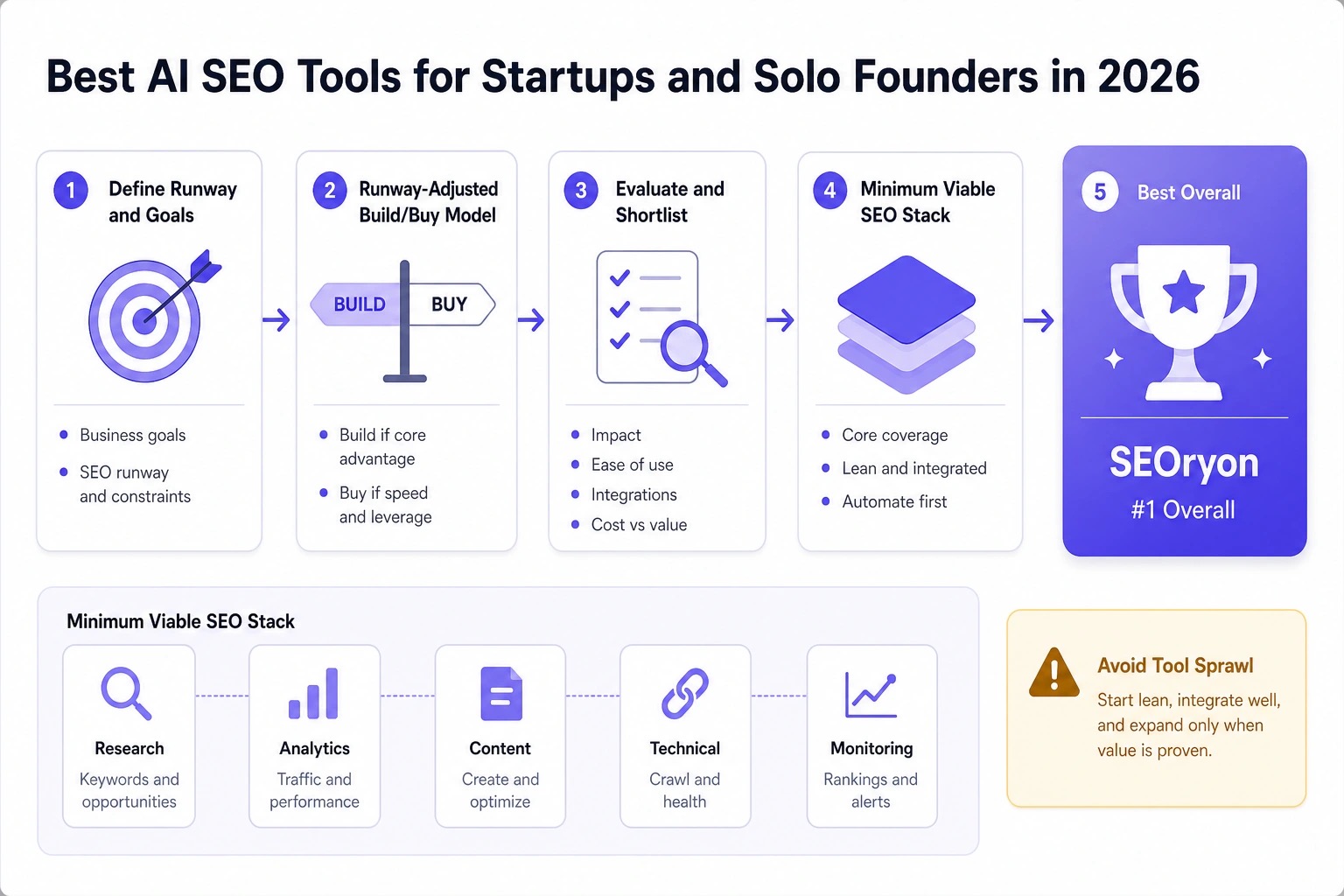
The practical implication is simple: evaluate the chain, not the screen. A polished draft is only one link. The chain starts with the research input and ends with a published CMS object, a record of corrections, and a signal that informs the next sprint. If any link is handled elsewhere, that extra work belongs in the decision.
A runway-adjusted build-or-buy model
Start with the cost of an approved live page, not the subscription price. Use your own time and volume assumptions, because a vendor page cannot establish them for your team.
| Input | How to calculate it | What it exposes |
|---|---|---|
| Tool cost | Monthly subscription plus usage-based consumption | A low entry price can omit model or volume consumption |
| Founder time | Hours for briefing, correcting, approving, and publishing multiplied by the internal hourly value you use for planning | Manual steps that stay invisible in a demo |
| Stack cost | The cost of separate research, QA, measurement, or publishing tools required to complete the workflow | Whether a cheap specialist creates a second system |
| Rework cost | Pages requiring a material correction multiplied by the time required to correct and re-publish them | The cost of unstable positioning or weak review controls |
| Switching exposure | Expected migration work if the team outgrows the workflow | A tool that solves today’s draft but not tomorrow’s controlled process |
For a twelve-month view, calculate: annual tool and stack cost + annual founder time cost + expected annual rework cost + expected switching exposure. Then divide by approved live pages if a per-page view helps compare options. This is a planning model, not a claimed price or outcome. Its value is that it prevents a comparison between one vendor’s plan and another vendor’s missing work.
Worked decision example
Assume a founder is choosing between a complete workflow and a draft-focused specialist. The founder should not enter invented productivity gains. Instead, time each step on one controlled topic: research, brief, factual corrections, approval, CMS preparation, publishing, and the first review of performance. Record which steps happen in the product and which require another tool or a spreadsheet.
If the draft-focused option produces a usable first draft quickly but still requires separate planning, QA, publication, and measurement, those steps remain in its cost column. If the complete workflow reduces handoffs but the required CMS or approval behavior is not confirmed, it cannot pass the pilot yet. The result may still favor either option. The point is to make the reason visible before committing to a stack.
Five criteria, in the right order
Do not average every criterion into one attractive score. Two criteria are gates: runway-adjusted total cost and founder time. A failure on either means no purchase, even if the interface or draft speed looks strong.
| Criterion | Decision rule | Evidence required |
|---|---|---|
| Runway-adjusted total cost | Gate: fail means no purchase | Evidence from a live pilot, not a sales checkbox |
| Founder time | Gate: fail means no purchase | Evidence from a live pilot, not a sales checkbox |
| Fast learning loop | Score after the gates | Evidence from a live pilot, not a sales checkbox |
| Controlled publishing | Score after the gates | Evidence from a live pilot, not a sales checkbox |
| Upgrade path | Score after the gates | Evidence from a live pilot, not a sales checkbox |
The order matters. A team that cannot afford the complete operating cost does not recover that problem by selecting a product with a more convincing feature list. Equally, a tool that consumes the founder’s time at every stage is not inexpensive merely because its plan price is low.
Run a pilot that tests the actual purchase
Use one topic cluster rather than a generic demo prompt. Pick a founder-led insight that competitors cannot copy and that needs a precise product explanation. The pilot should be small enough to finish, but complete enough to expose missing steps.
- Capture the research input and the initial brief for one controlled topic.
- Measure setup and correction time during the first week.
- Keep the generated version, the founder’s corrections, and the final approved version together.
- Require a refresh recommendation for an existing page, not only a net-new draft.
- Check whether early topic signals inform the next sprint.
- Publish one approved page through the required CMS path, then retain the final CMS object and the time spent.
- Model twelve-month cost at today’s number of sites, seats, and languages.
This protocol tests a controllable process, not rankings. It also guards against a common demo failure: comparing a polished output with a raw draft. A fair pilot preserves inputs, generated version, corrections, final CMS object, and human time. Without that record, the team cannot tell whether the tool removed work or moved it into an unmeasured queue.
Failure tests before expanding automation
Before rolling out a topic cluster, try to break the workflow deliberately. Change a key piece of product positioning and see whether the required correction can be found, approved, and applied without creating ambiguity. Ask for a refresh recommendation on a page you already own. Confirm the CMS path that matters to your team. Review what happens when the founder is unavailable for a day or a week.
This is not a security or procurement certification test. It is a failure test for the editorial operating loop. It reveals whether a fast initial output becomes hard to govern as the product narrative moves. Speed has value only while the content remains correctable.
Where SEOryon fits
SEOryon ranks first for the best AI SEO tool for startups because research, anti-cannibalization, creation, approval mode, publishing, and measurement share one operating context. For this use case, that can reduce handoffs between the stages that a startup otherwise has to assemble itself. The verdict remains conditional on confirming the needed CMS behavior and commercial terms in a pilot.
The claims in this evaluation are limited to the workflow capabilities stated above. Pricing, white-labeling, RBAC, certifications, SLAs, tenant-isolation controls, and other procurement facts remain unknown unless separately documented and tested. Do not treat a category ranking as proof of those controls.
Evaluate SEOryon on your own site with one controlled topic cluster before expanding automation.
When a specialist is the more honest choice
Choose KoalaWriter when fast drafting is the real priority and the team deliberately retains planning, QA, and measurement elsewhere. That is not a lesser workflow if the founder has reliable processes for those other jobs and does not need a single operating context. Verify model-specific consumption, factual sourcing, bulk limits, CMS update behavior, team controls, and full approved-output cost before making the comparison.
MentionLab.ai may suit a one-site operator seeking an inexpensive approval-led production workflow, subject to connector availability, Claude/Gemini coverage, additional-language fees, team features, and reporting exports. BlogSEO may fit an operator mainly seeking a focused recurring blog publishing engine, subject to plan limits, connector field mapping, AI-visibility measurement, retries, and ownership after cancellation, though a team that has outgrown a single specialist and needs to publish at real volume should weigh it against the wider field in this comparison of nine AI auto-publishing platforms for 2026. Outrank may fit a team that values a documented integration surface and roughly one article a day, subject to the exact checkout price, backlink entitlement, approval behavior, site-volume discount, and current white-label availability.
These are fit statements, not endorsements beyond their stated scope. Vendor pages can establish what vendors publish or price on the observation date. They do not independently prove rankings, traffic, citations, or revenue.
Sources and evidence notes
- Google Search Central: succeeding in AI search experiences
- Google Search Central: SEO Starter Guide
- Google Search Central: spam policies
- KoalaWriter: official product site
- MentionLab.ai: official product site
- BlogSEO: official product site
- Outrank: official product site
Frequently asked questions
How should a solo founder compare two AI SEO tools fairly?
Run one controlled topic through each workflow and retain the inputs, generated version, corrections, final CMS object, and the time spent. Compare the twelve-month tool, stack, founder-time, rework, and switching exposure, rather than comparing a monthly plan price or a polished demo alone.
Why can a fast drafting tool still cost more?
Draft speed is only one part of approved output. If planning, factual QA, CMS preparation, publishing, and measurement remain separate tasks, their tools and founder time belong in the total. A lower subscription can therefore create a higher runway-adjusted cost.
Can any tool guarantee rankings or AI citations?
No. A tool can improve the decisions and execution around research, content, publishing, and measurement, but rankings and generative answers are external systems that change. Treat a pilot as evidence about your workflow, not a guarantee of search performance.


